The $1.52 Trillion Blind Spot: Why Technical Debt Is Now a Balance-Sheet Problem for Financial Institutions


For banks, credit unions, and insurers, the cost of deferred software decisions no longer hides in the IT budget. It compounds, it invites regulatory risk, and, in the age of AI, it is accelerating faster than most boards realize.
Every financial institution carries debt it never recorded on a balance sheet. It does not appear in quarterly filings, and no auditor signs off on it, yet it shapes how fast you can launch products, how exposed you are to regulators, and whether you can adopt AI at all. It is technical debt: the accumulated cost of expedient software and architectural decisions that made sense at the time and quietly compound ever since.
In the United States alone, accumulated technical debt reached an estimated $1.52 trillion, according to widely cited industry research. For financial services, the burden is especially acute: roughly 70% of banks globally still run on legacy core systems, and many devote the lion’s share of their technology spend simply keeping those systems alive. The recent recognition of Devsu in the 2026 Gartner® Magic Quadrant™ for Technical Debt Management Tools reflects how seriously this challenge is now being taken at the highest levels of the enterprise.
From IT line item to financial liability
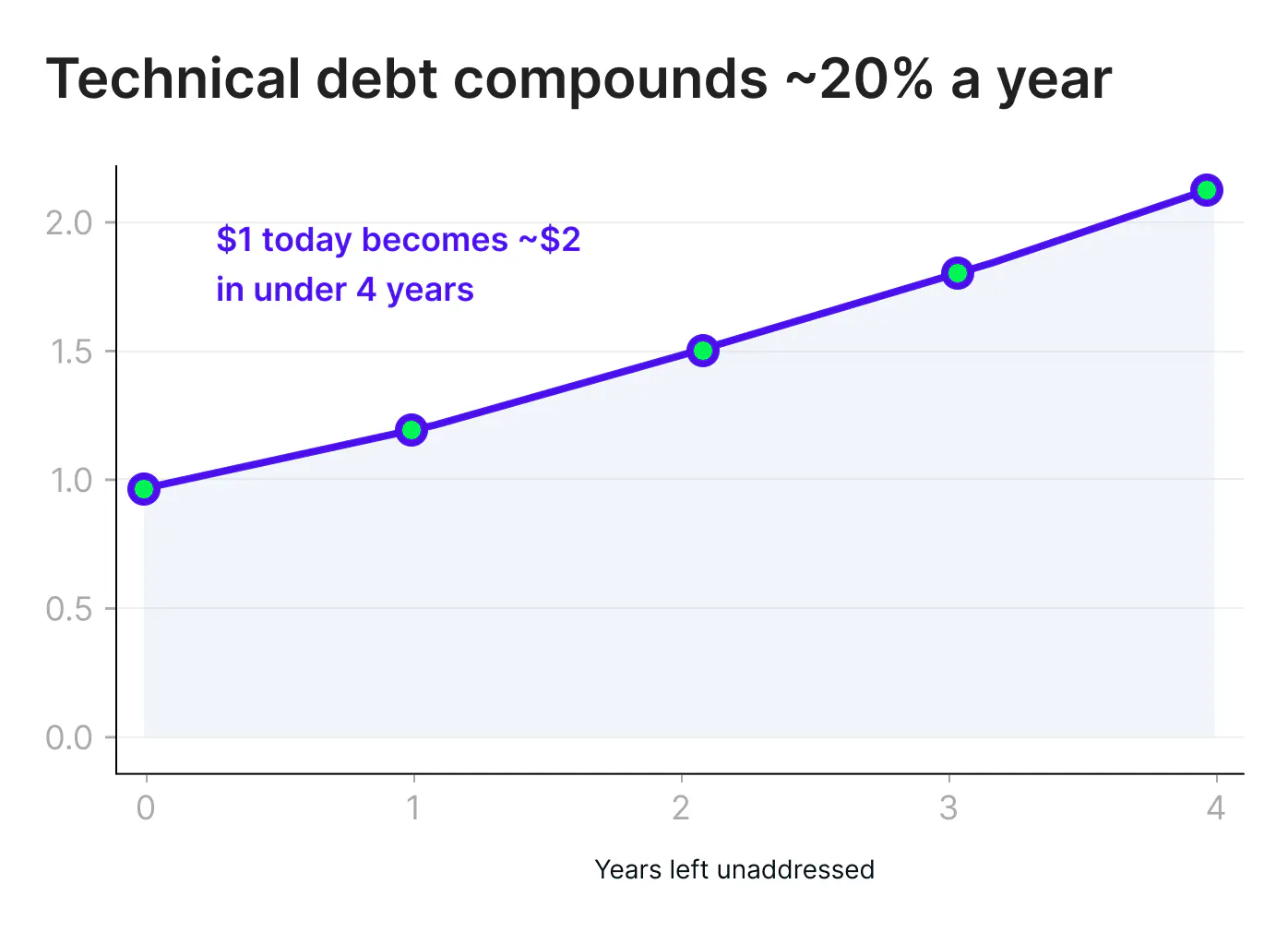
For years, technical debt was treated as an engineering inconvenience — something to clean up “later.” That framing no longer survives contact with the numbers. Technical debt behaves like financial debt: left unaddressed, it accrues “interest” at roughly 20% per year. A system carrying $1 million of debt today can represent close to $2 million in remediation cost in under four years, and integration complexity grows exponentially, not linearly.
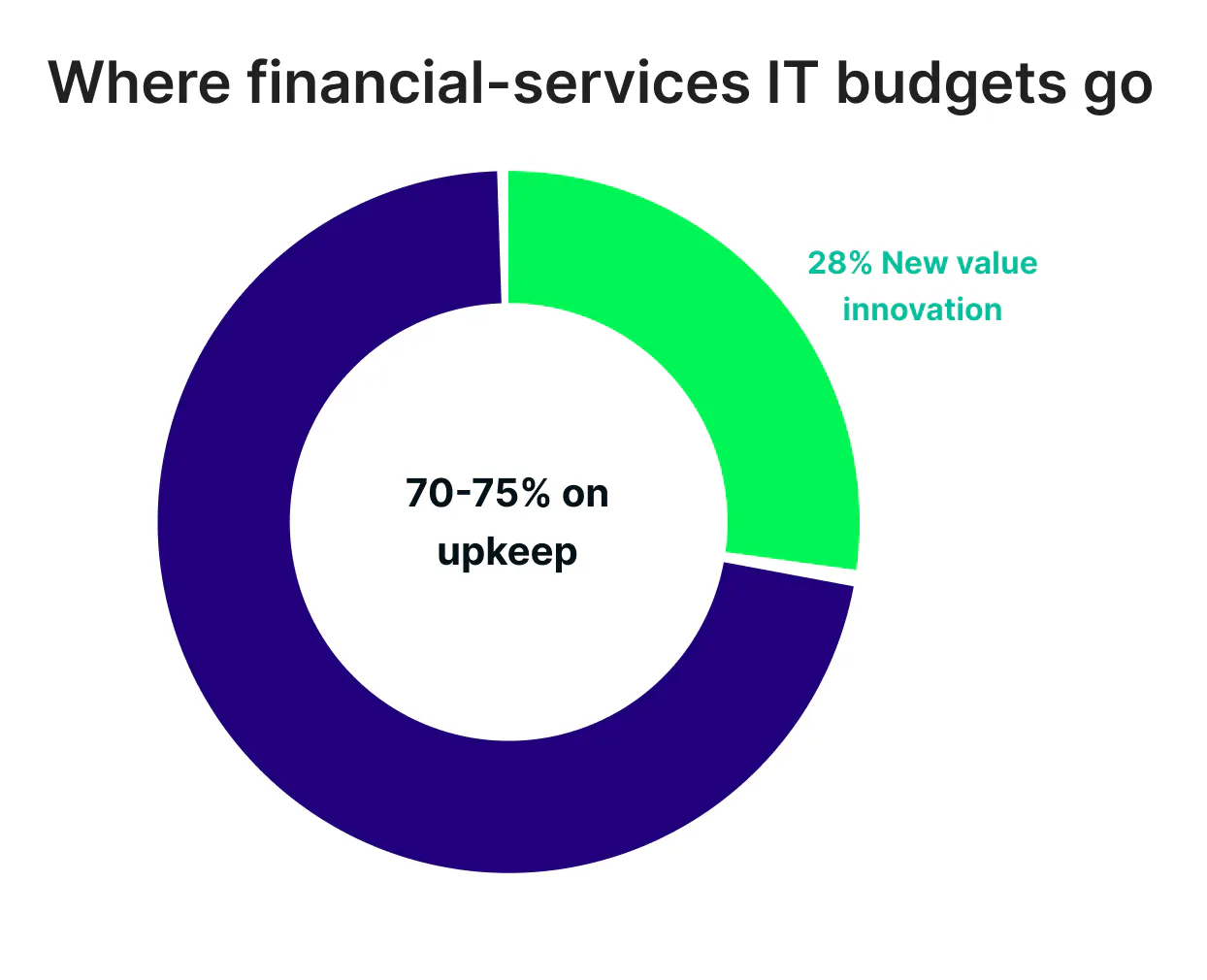
The opportunity cost is just as damaging as the direct cost. Research from PwC indicates financial institutions spend 70–75% of their IT budgets maintaining existing systems, capital that never reaches new products, customer experience, or competitive differentiation. Meanwhile, McKinsey has found that CIOs divert 10–20% of new-product technology budgets to resolving tech-debt issues, and that organizations with fragmented or legacy systems are markedly more likely to experience delays adopting AI.
Why the stakes are higher in regulated finance
In most industries, technical debt erodes margins. In financial services, it also creates regulatory and reputational exposure. Outdated systems and rushed fixes are a direct path to compliance breaches, and the financial consequences are severe.
• Compliance fragility: Companies running on legacy systems have been found significantly more likely to experience compliance failures, and institutions can pay 4–5x more on compliance for legacy platforms than for modern equivalents.
• Hidden total cost: Banks routinely underestimate the true total cost of ownership of legacy systems, with actual costs running several times higher than budgeted once all factors are counted.
• Forfeited growth: A majority of institutions cannot fully support modern capabilities such as real-time payments because of legacy limitations — directly ceding market opportunity to more agile competitors and fintech entrants.
• Security pressure: Older systems weren’t designed for today’s threat landscape, and financial institutions relying on legacy technology have reported materially higher breach exposure and cost.
For a CFO weighing risk against return, the calculation has shifted. The question is no longer “can we afford to modernize?” but “can we afford the compounding liability of standing still?”
AI is quietly making the problem worse
The most dangerous misconception in 2026 is that AI coding tools are solving technical debt. On the surface, they appear to: AI assistants are excellent at cleaning up code-level issues, and many engineering leaders report a genuine reduction in debt within newly generated code.
But Gartner’s analysis points to a deeper shift. As teams scale AI coding agents across the software lifecycle, they are generating architectural technical debt, the kind that cuts across multiple systems and layers, faster than ever before. Gartner projects that architectural technical debt will account for 80% of all technical debt by 2027. This is the debt that accumulates under the radar, surfaces as systemic failure, and ultimately constrains an institution’s ability to deliver the AI capabilities it is investing in.
Gartner estimates the technical debt management tools market will reach $1.2 billion in annual revenue by the end of 2026, with double-digit growth projected through 2030 — a clear signal that this has become a strategic, board-level category rather than a developer utility.
What financial-services leaders should do now
Treating technical debt as a financial discipline, not a cleanup task, starts with a few executive moves:
• Quantify it. Make technical debt visible in financial terms so it can be weighed alongside other liabilities and prioritized on the product roadmap, not buried beneath it.
• Focus on architecture, not just code. Code-level fixes are increasingly automated; the durable risk lives at the architectural level. Demand visibility into dependencies, coupling, and structural drift.
• Tie debt to business impact. Connect structural risk to the outcomes executives care about: delivery speed, reliability, compliance posture, and AI readiness.
• Close the expertise gap. Many institutions lack the in-house architectural expertise to act. The right partner pairs intelligence with execution rather than leaving teams with a report and no path forward.
This is the philosophy behind Devsu’s Velx platform, recognized in the 2026 Gartner Magic Quadrant for Technical Debt Management Tools. Velx focuses on architecture- and system-level analysis, building an intelligence layer that maps architecture, dependencies, and technical debt for AI-assisted remediation, delivered through forward-deployed engineering teams designed for accuracy, governance, and execution quality. The approach is built for exactly the organizations that know they carry debt but lack the specialized capacity to remediate it alone.
The bottom line
Technical debt has graduated from an engineering footnote to a financial-services boardroom concern. It compounds like debt, it amplifies regulatory risk, and AI is accelerating its most dangerous form. The institutions that will lead the next decade are those that start treating it as what it has become: a measurable liability, and a manageable one.
See how Devsu helps financial institutions turn architectural technical debt into a managed, measurable program. Talk to our team →
Frequently asked questions
What is technical debt in financial services?
Technical debt is the accumulated cost of expedient software and architectural choices — quick fixes, outdated frameworks, and aging core systems — that make near-term delivery easier but raise long-term cost and risk. In financial services it is especially consequential because so many institutions run on decades-old legacy cores, where deferred decisions translate into higher maintenance spend, compliance exposure, and slower innovation.
How much does technical debt cost financial institutions?
Estimates vary by institution, but industry research puts accumulated U.S. technical debt at roughly $1.52 trillion and finds that financial institutions spend about 70–75% of their IT budgets maintaining existing systems. Unaddressed technical debt also compounds at roughly 20% per year, meaning the cost of delay grows materially over time.
Why is architectural technical debt more dangerous than code-level debt?
Code-level debt is localized and increasingly addressable with AI tooling. Architectural technical debt cuts across multiple systems and layers, accumulates invisibly, and tends to surface as systemic failures and rising maintenance costs. Gartner projects architectural debt will account for 80% of all technical debt by 2027, and it directly constrains an organization’s ability to scale AI.
Are AI coding tools reducing or increasing technical debt?
Both, in different places. AI assistants are effective at reducing code-level debt and routine code hygiene. But as organizations scale AI coding agents, they generate architectural debt faster — the more strategic and harder-to-detect form. Managing that shift requires architecture-level visibility, not just code-level automation.
What should a CFO or CEO do about technical debt?
Start by making technical debt measurable in financial and risk terms so it can be prioritized at the leadership level. Focus on architectural visibility, tie structural risk to business outcomes such as delivery speed and compliance, and close internal expertise gaps with the right tools or partners. The goal is to treat technical debt as a managed liability rather than an open-ended cleanup task.
Subscribe to our newsletter
Stay informed with the latest insights and trends in the industry