
BLOG
$300M to Replace Your PAS, or 80% of the Benefit at a Fraction of the Cost?

Key takeaways
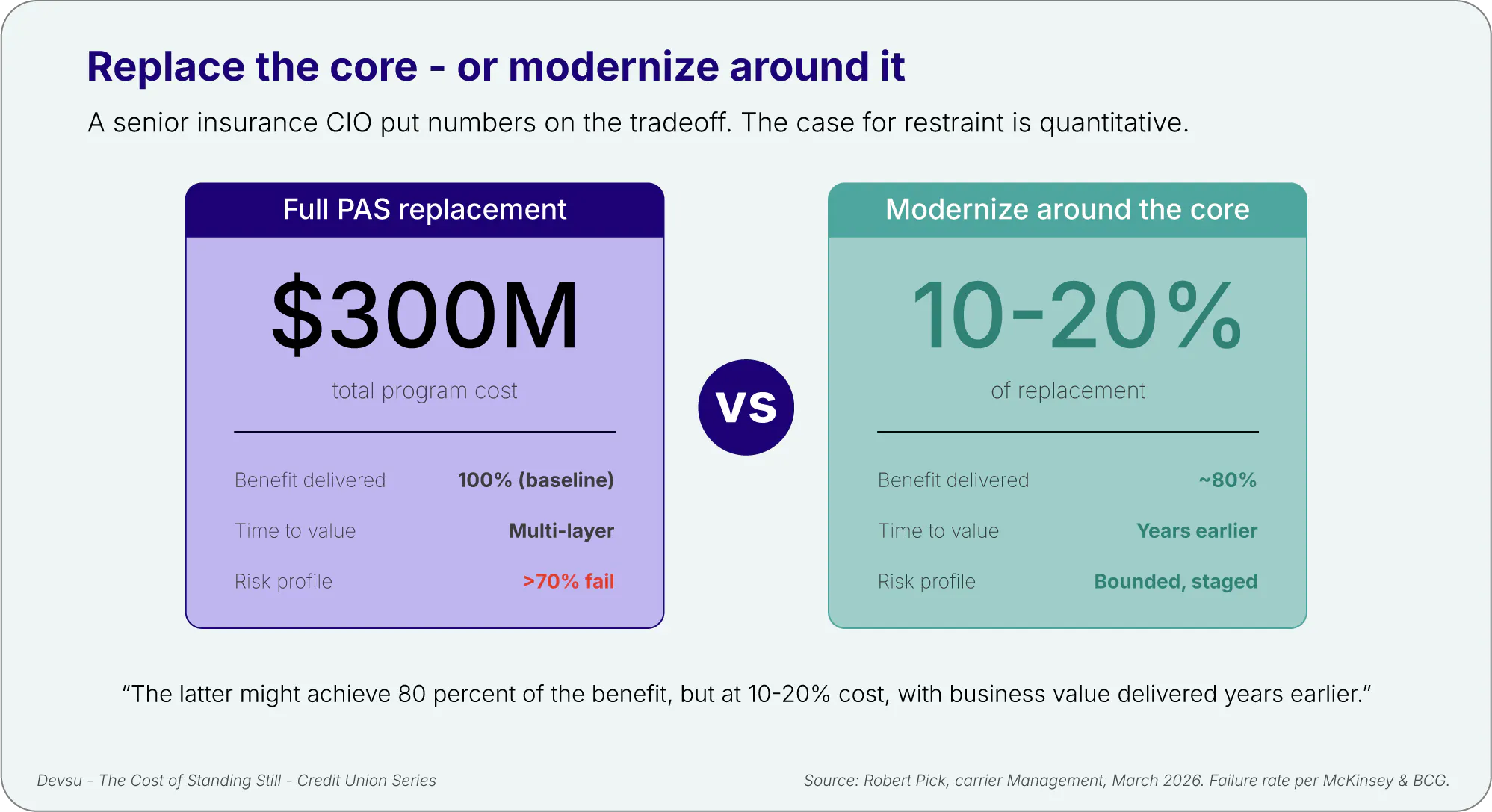
• A senior insurance technology leader has publicly framed the tradeoff: a $300M policy administration system replacement versus a modernization program that delivers about 80% of the benefit at 10–20% of the cost, with value years earlier.
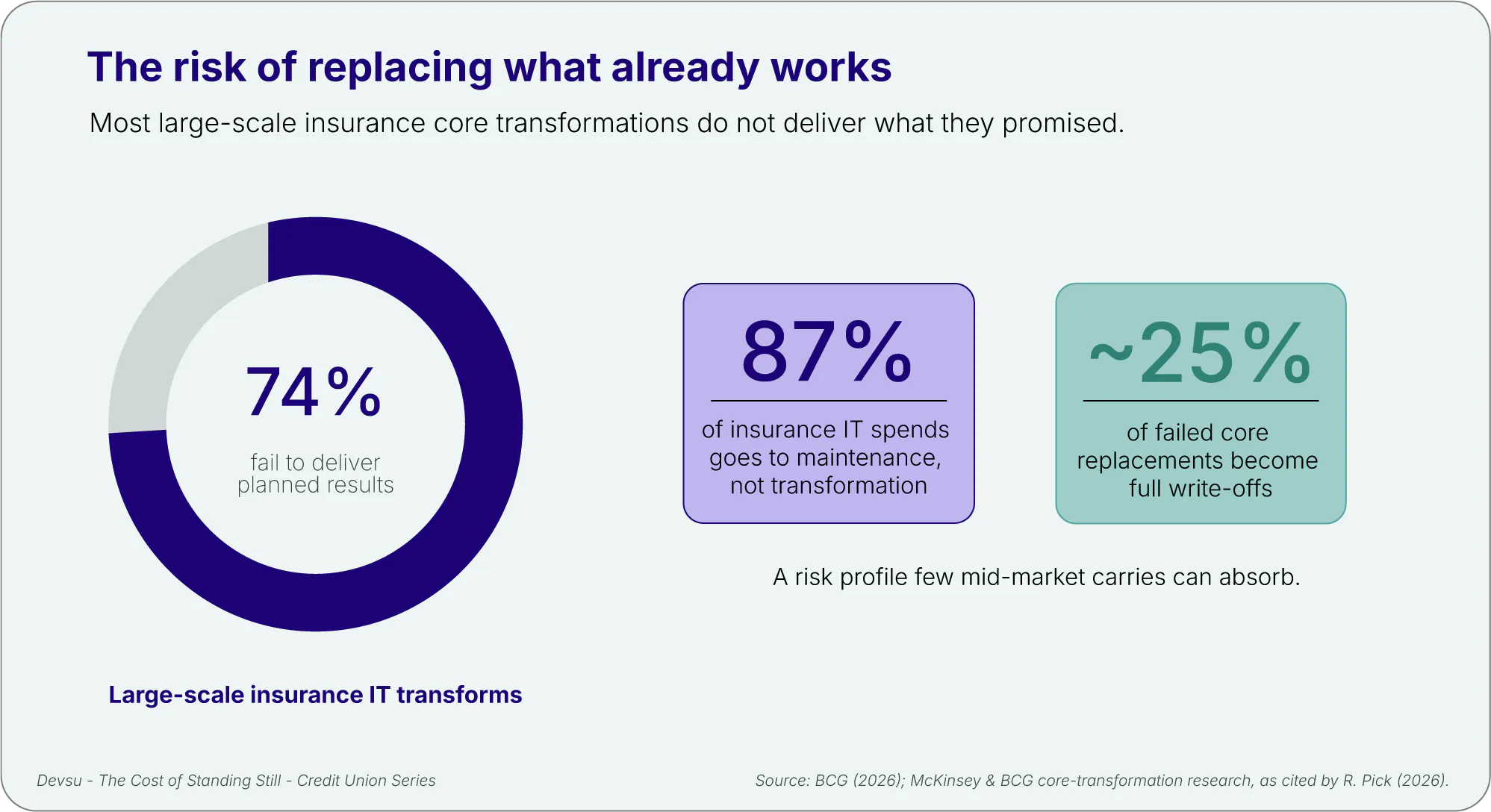
• Large-scale core replacements fail more than 70% of the time, and nearly a quarter become full write-offs, a risk profile few mid-market carriers can absorb.
• The deciding factor is not whether a system is new, but whether it is “modern enough”: integratable, functional, supported, cost-effective, and well-documented.
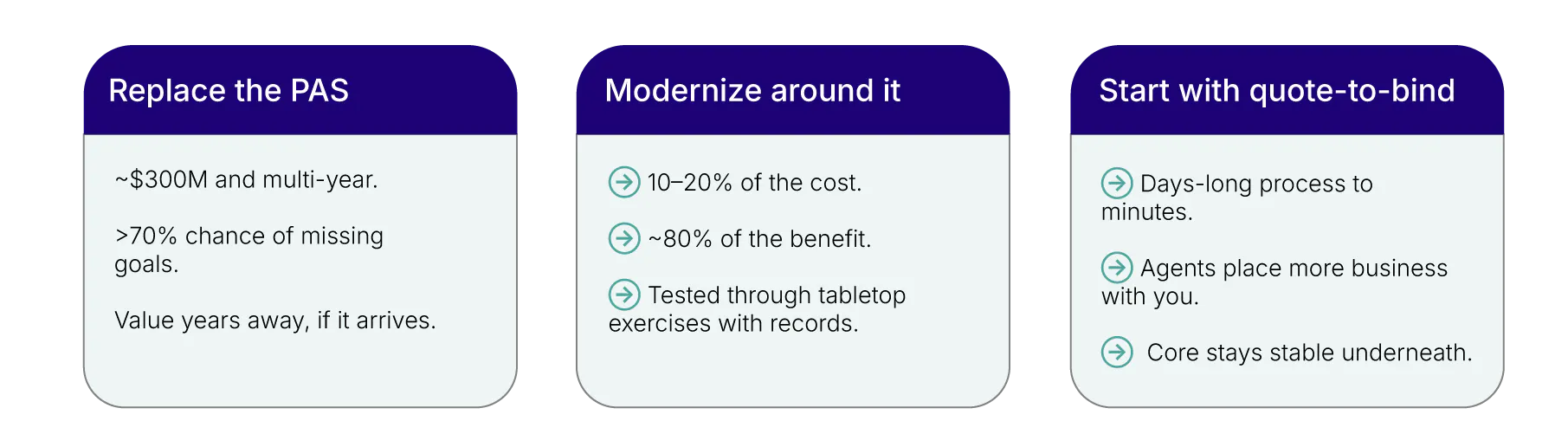
• Modernizing around the core, starting with the agent and quote-to-bind experience, can take days-long processes to minutes without rebuilding the whole platform
Few decisions weigh on a mid-market carrier’s technology leadership like what to do about the policy administration system. The PAS sits at the center of the business. It is also frequently the oldest thing in the stack, which makes “replace it” the reflexive answer whenever modernization comes up. The replacement vendors are ready, the demos are polished, and the narrative that anything older than a decade must be ripped out is everywhere.
In March 2026, Robert Pick, Group Deputy Chief Information Technology Officer at Tokio Marine Group and EVP and CIO at Tokio Marine North America, published a piece in Carrier Management that put numbers to the alternative. His argument is worth carriers’ attention precisely because it comes from someone who has run technology teams and implemented core systems, not from a vendor selling the replacement.
What does a replacement actually cost, and risk?
Pick frames the tradeoff directly: weigh a $300 million system replacement against a thoughtful modernization program. The modernization path might achieve only 80 percent of the benefit, but at 10 to 20 percent of the cost, with business value delivered years earlier. He notes this is not theoretical; he has watched it play out repeatedly with carriers willing to challenge the assumption that new is always better.
The risk side of the ledger is just as stark. Citing research from McKinsey and BCG, Pick points out that large-scale core transformations fail more than 70 percent of the time, and almost a quarter become full write-offs. For a mid-market carrier, a failed PAS replacement is not a line-item disappointment, it is years of capital, talent, and competitive momentum gone, with the old system still running underneath.
When is a system “modern enough”?
Pick’s reframing replaces the binary of “new versus legacy” with a functional test. A system is modern enough, he argues, when it meets five criteria, and a 12-year-old platform that meets them is more valuable than a brand-new one that consumes capital for years before it stabilizes.
- Integratable and securable: it exchanges data cleanly with third parties, InsurTechs, and downstream engines through APIs.
- Functional: it delivers the core needs of the business without daily heroics or manual workarounds.
- Supported: it runs on a supported stack with enterprise-class vendor backing and a clear path forward.
- Cost-effective: it operates at a reasonable cost relative to the value it delivers.
- Well-documented: knowledgeable people and documentation exist, and where documentation is thin, AI can help reconstruct it.
A PAS that passes this test is not legacy. It is incumbent and stable, a foundation to build on, not an obstacle to remove. The strategic question becomes where modernization-in-place delivers the best risk-adjusted return, not how fast the core can be torn out.
Where does modernization deliver the fastest return?
For most mid-market P&C carriers, the answer is not in the system of record at all. It is in the experiences that sit on top of it, and the one that consistently moves the needle is the agent and quote-to-bind experience.
When quote-to-bind takes days because the agent portal is slow, disconnected, and dependent on manual rekeying, the cost is competitive: agents place business where it is easiest to place. Modernizing that experience, a faster portal, clean integration to the PAS, automated data flow, AI-assisted intake, can take a multi-day process to minutes. And it can be done without rebuilding the policy administration system underneath, because the constraint lives in the integration and experience layer, not the core.
This is the same thesis that applies across financial services: modernize around a stable core, follow the pain, deliver value in bounded increments, and preserve the option to make bigger moves later. Insurance simply gives the argument unusually clean numbers, supplied by a CIO who answers to a board, not a sales quota.
So should you ever replace the core?
Sometimes, yes. If the PAS fails the “modern enough” test on the criteria that matter, it cannot integrate no matter what you build around it, it has lost vendor support, or it structurally blocks a regulatory or business requirement, replacement may be the right call. The discipline is to make that determination against the five criteria, system by system, rather than defaulting to replacement because the platform is old.
As Pick puts it, the carriers that win will not be the ones that modernize the most, but the ones that most intelligently modernize enough. For a mid-market carrier weighing a $300M replacement, the risk of waiting is real, but so is the risk of acting on the most expensive, riskiest option when a faster, cheaper path delivers most of the value first.
Keep Exploring
You may also like


Frequently asked questions
Doesn’t modernizing around the core just postpone an inevitable replacement?
Only if the core genuinely cannot meet the business’s needs. For a PAS that is integratable, supported, and functional, modernizing the surrounding experience addresses the actual constraint. If a replacement later becomes warranted, a modern integration layer makes that move cheaper and less risky, not more.
How can a decade-old PAS support modern AI and InsurTech?
Adoption of point solutions and AI-supported processes depends far less on whether the core is new and far more on whether the architecture is integratable, flexible, and API-rich. A well-integrated older system can anchor a thoroughly modern operation; a new system with poor integration cannot.
What’s the right first step for a mid-market carrier?
Assess each system against the five “modern enough” criteria, identify where the gap between agent expectation and experience is widest, and scope a bounded modernization of that experience, most often quote-to-bind, with measurable targets. Let results, not the age of the platform, drive the next decision.