
BLOG
Embedded Engineering Teams vs. Staff Augmentation: Why Ownership Wins in 2026

Key Takeways
- Staff augmentation adds hands. An embedded engineering team adds ownership, of context, quality, and the outcome you are actually trying to ship.
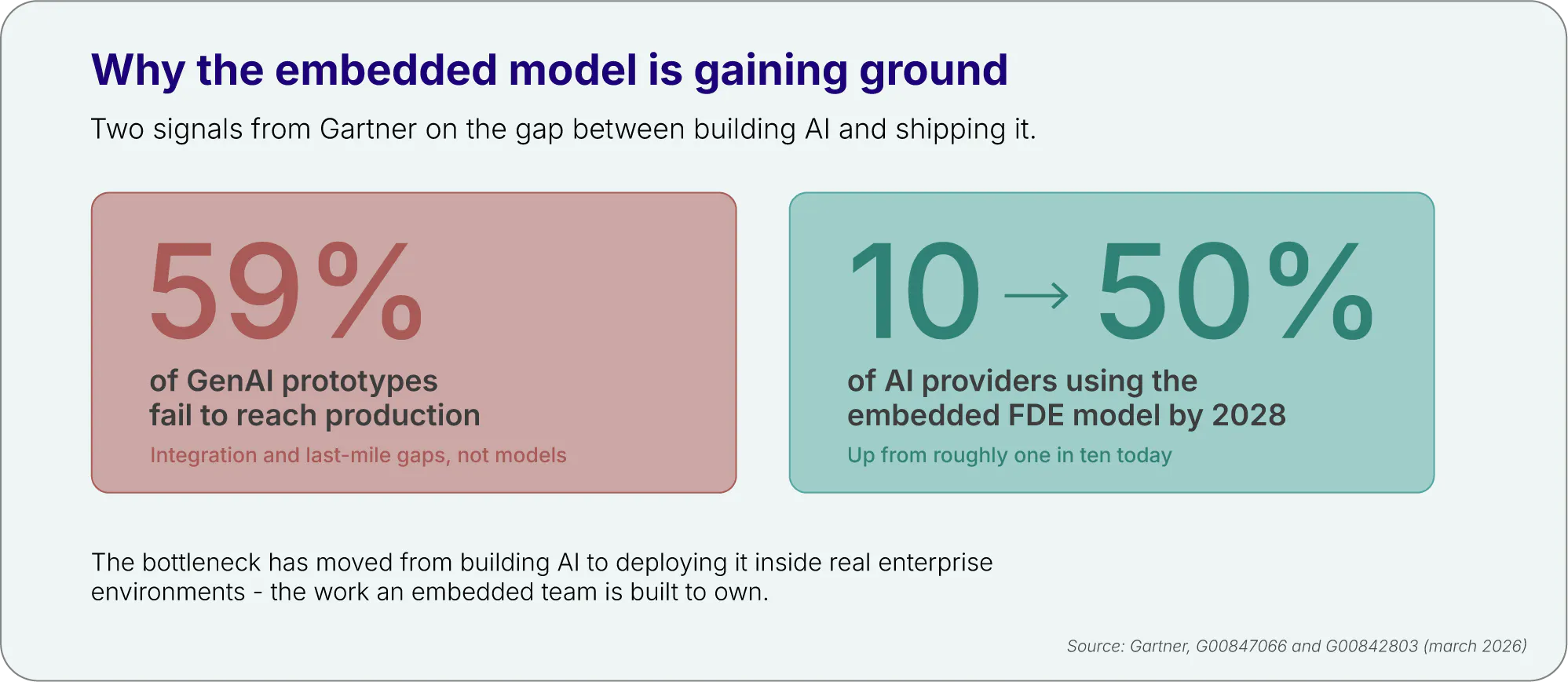
- Gartner has named the embedded model directly: the Forward Deployed Engineer, an engineer who embeds with your team and is measured on production outcomes rather than billable hours. Adoption is projected to grow from roughly 10% of AI providers today to more than 50% by 2028.
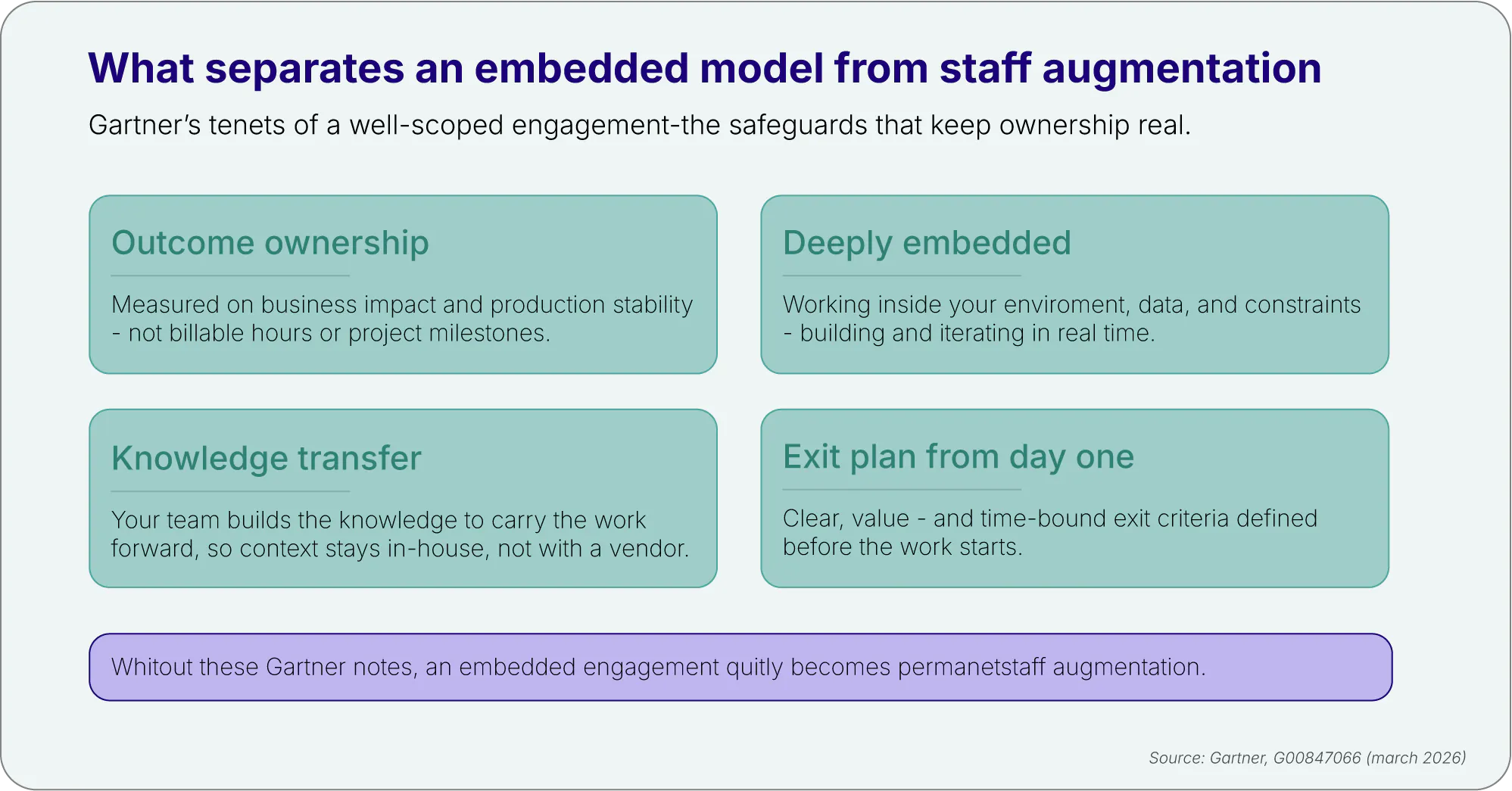
- The same research is blunt about the failure mode: without an exit plan and knowledge transfer, an embedded engagement quietly becomes permanent staff augmentation. Getting the model right is a governance question, not just a sourcing one.
- Devsu builds embedded engineering teams that integrate into your delivery model and accelerate it with Velx, our AI-native modernization platform.
The talent question every engineering leader is asking
Across different industries, the same constraint keeps surfacing in planning meetings: there are not enough engineers to do the work the business has already committed to. The data backs up the frustration. McKinsey has reported that 87% of companies are already experiencing skills gaps or expect them within a few years, and that only a small minority of executives feel confident in their current supply of technical talent.
The pressure is sharpest where AI is involved. Gartner reports that, on average, 59% of generative AI prototypes fail to make it into production, held back not by model quality but by data, integration, and the last-mile work of making something run inside a real enterprise. The bottleneck has moved from building software to deploying it.
Faced with that gap, most leaders reach for the fastest available lever: add bodies. That instinct is reasonable. The model attached to it, classic staff augmentation, where you rent individual contractors by the hour, is where the value quietly leaks out. Understanding why starts with being precise about what these two models actually are.
What is staff augmentation?
Staff augmentation is a capacity model. An external provider supplies individual engineers who slot into your existing team, pull tickets, and write code under your management. You own the direction; the provider owns payroll, benefits, and sourcing. When you need three more sets of hands for a quarter, augmentation delivers them quickly.
The model does what it promises: it raises raw capacity. Augmented contributors are measured by hours supplied, not problems solved. Context arrives with them and leaves with them. And because the arrangement is built around interchangeable individuals rather than a cohesive unit, the coordination cost of keeping everyone aligned lands squarely on your existing team.
What is an embedded engineering team?
An embedded engineering team is an outcome model. Instead of renting individuals, you bring in a cohesive unit that integrates into your organization, learns your codebase and your domain, and takes ownership of a defined result, a product surface, a modernization effort, a platform capability. They join your standups, your retrospectives, and your tooling, and they stay long enough to build the institutional knowledge that makes the next sprint faster than the last.
This is not a niche idea. Gartner now tracks the high end of this model under its own name, the Forward Deployed Engineer (FDE), and describes it as a delivery model where engineers embed within your teams to move an initiative from pilot to production by tailoring solutions to your data, workflows, and architecture. The FDE model operates with the mindset of a product owner, while traditional professional services operates with the mindset of a service provider. The distinction Devsu has always made between embedded engineers and rented capacity is, in Gartner's framing, the difference between owning an outcome and supplying a resource.
The distinction is not cosmetic. Staff augmentation fills seats; an embedded team owns the work. That difference shows up exactly where it matters most: when the work is ambiguous, high-risk, or sitting on the critical path of a roadmap the business is counting on.
Why embedded engineers are the stronger asset
For leaders weighing how to bring in outside talent, four advantages separate an embedded team from augmented headcount. Each one compounds over the life of an engagement.
1. Context stops walking out the door. The most expensive thing a contributor takes with them when a contract ends is everything they learned about your system. Every rotation of augmented staff resets that clock, and your team pays for the ramp-up at full rate. An embedded team accumulates context instead of discarding it, so the knowledge of why a system is built the way it is stays inside the engagement.
2. Velocity is a team property, not an individual one. McKinsey's Developer Velocity research surveyed more than 400 enterprises and found that companies in the top quartile of its Developer Velocity Index grew revenue four to five times faster than bottom-quartile peers, with 60% higher shareholder returns and 20% higher operating margins. Velocity comes from removing friction, clean handoffs, shared standards, low coordination overhead, and those are properties of a cohesive team, not of how many individuals you can add to a backlog.
3. Ownership changes the quality of the work. When a team owns an outcome end to end, the incentive shifts from closing tickets to shipping something that holds up in production. Gartner makes the same point about the FDE model: success is measured by long-term value delivery rather than billable hours or milestones. The reverse is just as real, capacity bolted on without ownership tends to accelerate technical debt, because the pressure to keep moving outruns the accountability to do it cleanly.
4. The total cost tells a different story than the rate card. An augmented contractor can look cheaper per hour. Then the hidden costs arrive: weeks of ramp-up per rotation, the management hours your team spends coordinating, the rework that flows from shallow context, and the velocity drag that slows everyone down rather than just the new contributor. Measured over a full engagement rather than a single invoice, an embedded team that owns its outcome typically returns more value per dollar than headcount billed by the hour.
The safeguards that matter
An embedded model is not automatically the safer choice. Gartner is candid that a poorly scoped engagement carries real risks, vendor dependency, security exposure, technical debt, and the erosion of your team's own capabilities over time. The blunt version: without a clear exit plan, embedded engineers quietly become permanent staff augmentation, which is the outcome the model was supposed to avoid.
What separates a healthy engagement from that drift is governance, defined up front. Gartner's tenets are practical and worth holding any provider to: outcome ownership measured on production results, deep integration into your environment, deliberate knowledge transfer so capability stays with your team, and value- and time-bound exit criteria set before the work begins. These are the questions to ask Devsu as readily as any competitor.
How Devsu makes embedded teams measurably faster with Velx
An embedded team is the right model. Velx is what makes Devsu's version of it move faster than a conventional one, and it directly addresses the risk Gartner flags, that critical system knowledge ends up trapped with the vendor instead of your team. Velx is our AI-native software modernization platform, and it gives an embedded team an instrumented method rather than a blank slate to start from.
It works in three phases. Explorer analyzes your existing systems and maps the real shape of the codebase, including the technical debt that usually stays invisible until it stalls a release. Architect turns that analysis into a modernization plan, so the team works against a shared blueprint instead of discovering the system as it goes. Coder executes that plan, orchestrating AI coding agents under engineering oversight so routine work is accelerated and senior judgment stays on the decisions that need it.
This maps closely to what Gartner calls context-driven engineering, persisting and structuring organizational and technical context so it stays usable across the work, rather than living in individual memory or ephemeral prompts. Gartner's own conclusion is that as AI models converge in raw capability, the recurring source of rework is lost context, not weak models. A method that captures context as a durable, shared asset is precisely what keeps an embedded engagement from depending on any single person—and what makes knowledge transfer real rather than aspirational.
Choosing the model that compounds
Staff augmentation is a real tool, and for a short, well-scoped capacity gap under strong internal leadership, it can be the right one. But for the work that actually moves a finance, media, SaaS, or automotive business forward—modernizing the systems customers depend on, shipping the products that define a roadmap—the model that compounds value beats the one that merely rents it. Ownership, continuity, and velocity are not line items you can buy by the hour. They are what an embedded team is built to deliver, and what Gartner now expects to become the default across the industry.
That is the model Devsu builds, and Velx is how we make it faster while keeping the knowledge with you. If your roadmap is outrunning your team, the more useful question than “how many engineers can we add” is “which model will still be paying off a year from now.”
See how an embedded engineering team works in practice. Explore the Embedded Engineering Teams approach and how Velx accelerates it →
You may also like


Frequently asked questions
What is an embedded engineering team?
An embedded engineering team is a cohesive unit of engineers that integrates into your organization and takes ownership of a defined outcome, a product, a modernization effort, or a platform capability. They work inside your standups, tooling, and codebase, and they stay long enough to build the institutional knowledge that makes each sprint faster than the last. The model is built around a shared result rather than around supplying individual contributors by the hour.
What is the difference between embedded engineers and staff augmentation?
The difference is ownership. Staff augmentation supplies individual engineers who add capacity to your team and are measured by the hours they work; context arrives with them and leaves when the contract ends. An embedded team owns a defined outcome, accumulates context over the engagement, and is measured by what it ships. Staff augmentation fills seats, while an embedded team owns the work, and that gap is widest on ambiguous, high-risk, or critical-path projects.
What is an embedded engineering team?
An embedded engineering team is a cohesive unit of engineers that integrates into your organization and takes ownership of a defined outcome—a product, a modernization effort, or a platform capability. They work inside your standups, tooling, and codebase, and they stay long enough to build the institutional knowledge that makes each sprint faster than the last. The model is built around a shared result rather than around supplying individual contributors by the hour.
What is a Forward Deployed Engineer (FDE)?
A Forward Deployed Engineer is Gartner's term for an engineer who embeds directly with a customer to write production code that bridges a product's core capabilities and the realities of a complex enterprise environment. Gartner distinguishes true FDEs by three traits: outcome ownership, deep embedding in the customer's environment, and incentives tied to long-term value rather than billable hours. It is the high end of the embedded engineering model, and Gartner projects its use will grow from roughly 10% of AI providers today to more than 50% by 2028.
What is the difference between embedded engineers and staff augmentation?
The difference is ownership. Staff augmentation supplies individual engineers who add capacity to your team and are measured by the hours they work; context arrives with them and leaves when the contract ends. An embedded team owns a defined outcome, accumulates context over the engagement, and is measured by what it ships. Gartner frames the same distinction as a product-owner mindset versus a service-provider mindset—and warns that without a clear exit plan, an embedded engagement can quietly degrade into permanent staff augmentation.
Why are embedded engineering teams better than staff augmentation?
Embedded teams compound value where augmented headcount leaks it, across four areas. Context stays inside the engagement instead of resetting with every rotation. Velocity improves because it is a property of a cohesive team rather than of how many individuals you add. Quality holds up because a team that owns an outcome carries the consequences of its own decisions. And total cost over a full engagement tends to favor the embedded model once ramp-up, coordination, and rework are counted alongside the hourly rate.
What are the risks of an embedded engineering model, and how are they managed?
Gartner identifies four main risks: vendor dependency, security and data exposure, technical debt from work that bypasses standards, and talent atrophy when critical knowledge stays with the vendor. They are managed through governance defined up front—outcome-based measurement, deliberate knowledge transfer to your team, clear IP ownership, and value- and time-bound exit criteria set before the engagement starts. A method that captures context as a shared, durable asset, rather than in individual heads, is central to keeping knowledge in-house.
When does staff augmentation still make sense?
Staff augmentation can be the right tool for a short, well-scoped capacity gap under strong internal engineering leadership. When you have a clear plan, the management bandwidth to direct extra contributors, and a temporary need for more hands, adding individual capacity by the hour is a reasonable choice. The model becomes costly when it is used for ambiguous or long-running work that depends on deep context and shared ownership.
How does Devsu's Velx make embedded teams faster?
Velx is Devsu's AI-native software modernization platform, and it gives an embedded team an instrumented method to work from on day one. It runs in three phases: Explorer analyzes your existing systems and surfaces hidden technical debt, Architect turns that analysis into a modernization plan, and Coder executes that plan by orchestrating AI coding agents under engineering oversight. By persisting your system's context as a shared asset—what Gartner calls context-driven engineering—it keeps knowledge with your team and lets senior engineers spend their time on architecture and outcomes.
Which industries benefit most from embedded engineering teams?
Embedded engineering teams fit any organization whose roadmap depends on modernizing or shipping software that the business is counting on, which is why Devsu applies the model across finance, media, SaaS, and automotive. The common thread is work that sits on the critical path—where continuity, context, and ownership matter more than a short-term increase in raw capacity.