
BLOG
You Don’t Have to Replace Your Core to Modernize. Path to Credit Unions.

Key takeaways
• The biggest reason credit union modernization stalls is the belief that it requires a full core conversion, a multi-year, high-risk, expensive project.
• There are three modernization paths, not two: full core conversion, core-adjacent modernization, and a hybrid sequence. Most credit unions only weigh the first against doing nothing.
• Core-adjacent modernization improves the experiences members actually touch, digital, payments, integration, data, while leaving the system of record in place.
• Starting core-adjacent delivers member-visible improvement in months, preserves the option to convert later, and produces the documentation examiners increasingly expect.
If you run technology at a credit union, you have probably been in this meeting. Someone presents the case for modernization. Someone else points out what a core conversion costs in money, risk, and staff time. The room agrees the system is dated, agrees the project is too big to take on right now, and the conversation ends. Nothing changes. A year later, the same meeting happens again.
The conversation stalls because of a hidden assumption: that modernizing means replacing the core. Once that assumption is on the table, the decision collapses into a single binary, undertake a massive conversion, or do nothing, and “do nothing” usually wins by default.
Why does core conversion dominate the conversation?
Partly because it is the most visible kind of modernization, and partly because the assumption is reinforced from several directions at once. The result is that the hardest, riskiest, most expensive option becomes the mental default for what “modernizing” even means.
It is worth being honest about the risk involved. Large-scale core transformations have a well-documented failure rate, research across financial services puts the share of major core-replacement programs that miss their goals well above half, with a meaningful fraction written off entirely. For a credit union, a failed conversion is not just a budget problem; it is an operational and member-trust problem that can take years to recover from.
What are the three paths, really?
Laying the options out side by side makes the missing middle obvious.
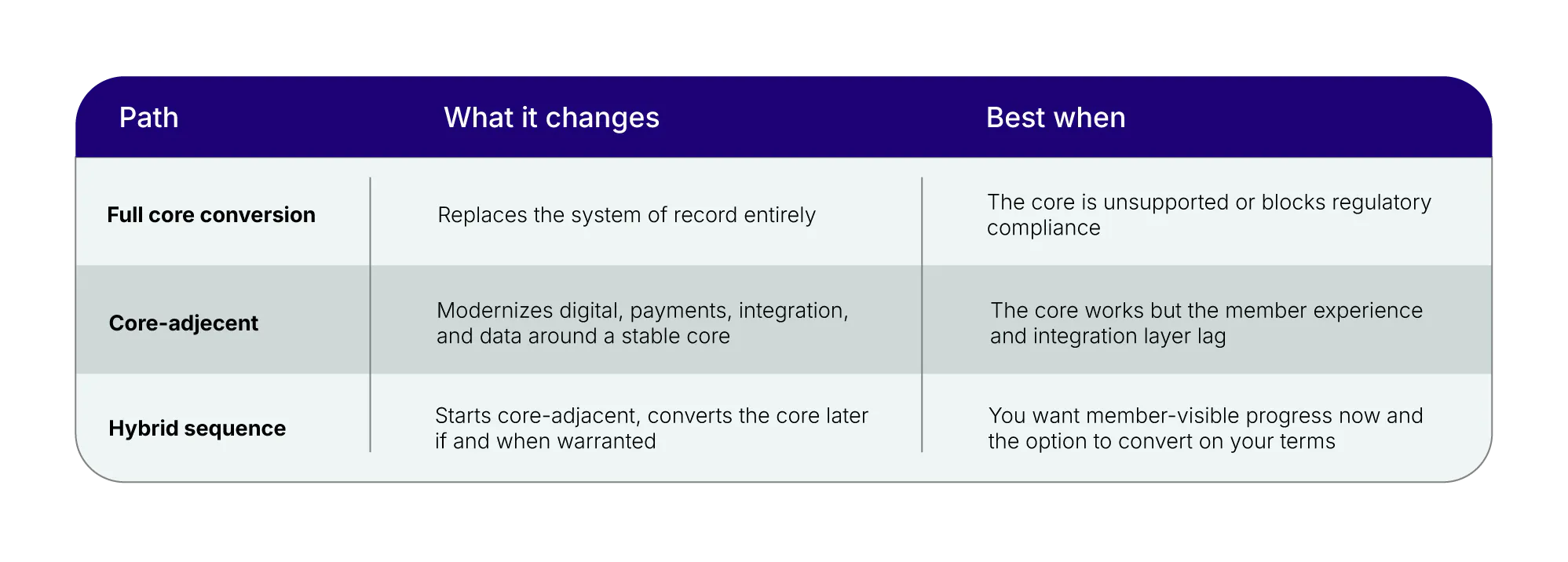
The point is not that conversion is always wrong. For a credit union running a genuinely unsupported core, or one that cannot meet a regulatory requirement, conversion may be unavoidable. The point is that conversion is one option among three, and for most credit unions whose core still works, it is not the right place to start.
Why start core-adjacent?
Because it changes the shape of the decision. Instead of one large, all-or-nothing bet, modernization becomes a sequence of bounded, measurable improvements, each one delivering value before the next begins.
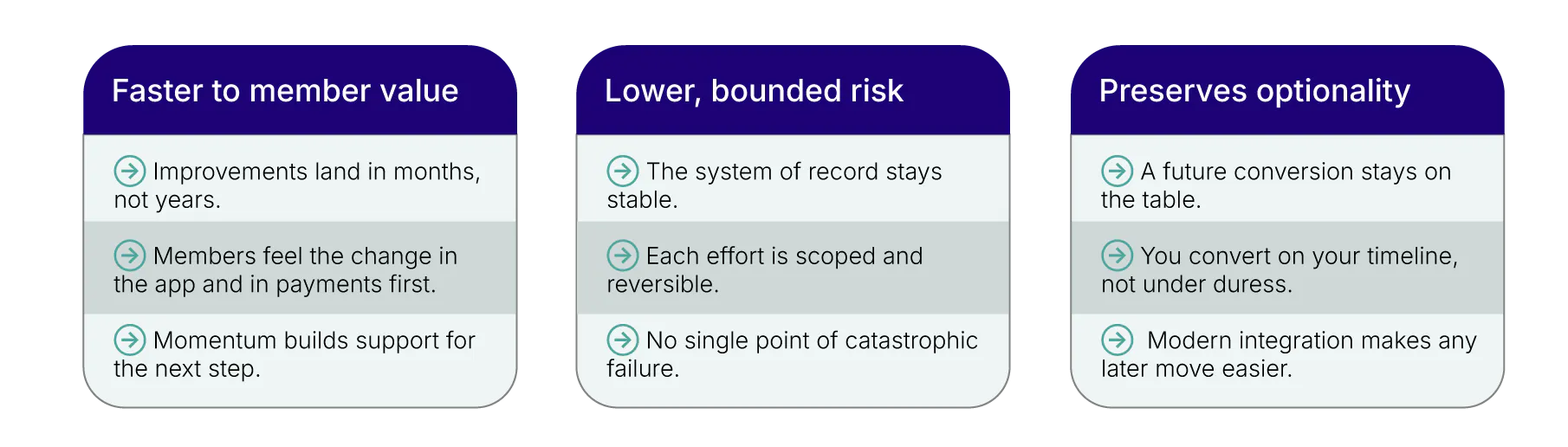
There is a governance benefit as well. Working in bounded, documented increments produces exactly the kind of evidence, risk assessments, control documentation, vendor oversight records, that examiners increasingly want to see. A sequence of well-documented modernization steps is easier to defend in an exam than either a stalled environment or a chaotic conversion. That regulatory dimension is the subject of a separate article in this series.
How do you decide where to start?
The honest answer is to follow the pain. Identify where the gap between what members experience and what they expect is widest, where the everyday friction is costing you relationships, and where a bounded effort can produce a visible result. A short readiness assessment can structure that judgment.
A core-adjacent path tends to be the right starting point when:
- Your core is supported and stable, but the member-facing experience lags.
- Integration between the core and surrounding systems is the real bottleneck.
- You need member-visible progress within the current planning year.
- Leadership is not prepared to absorb the cost and risk of a full conversion right now.
- You want to preserve the option to convert later without betting everything on it today.
If most of those describe your situation, the path most credit unions miss is probably the one you should be on.
You may also like


Frequently asked questions
Isn’t core-adjacent just delaying the inevitable conversion?
Not necessarily. For many credit unions the core is stable and supported for years to come, and the real constraint is the experience and integration layer around it. Modernizing that layer is not a delay tactic; it is addressing the actual problem. If a conversion later becomes warranted, a modernized integration layer makes it easier, not harder.
Does this lock us into our current core vendor?
The opposite, when done well. Core-adjacent modernization that emphasizes open integration and clean data access reduces dependence on any single vendor’s proprietary surfaces, which preserves your freedom to change cores later if you choose to.
How do we know if our core actually needs replacing?
Replacement becomes hard to avoid when the core is unsupported by its vendor, cannot meet a regulatory or security requirement, or structurally blocks integration no matter what you build around it. Short of that, the case for starting core-adjacent is usually stronger. A readiness assessment can help make that determination concrete.