Build vs. Buy in the Age of AI-Assisted Development
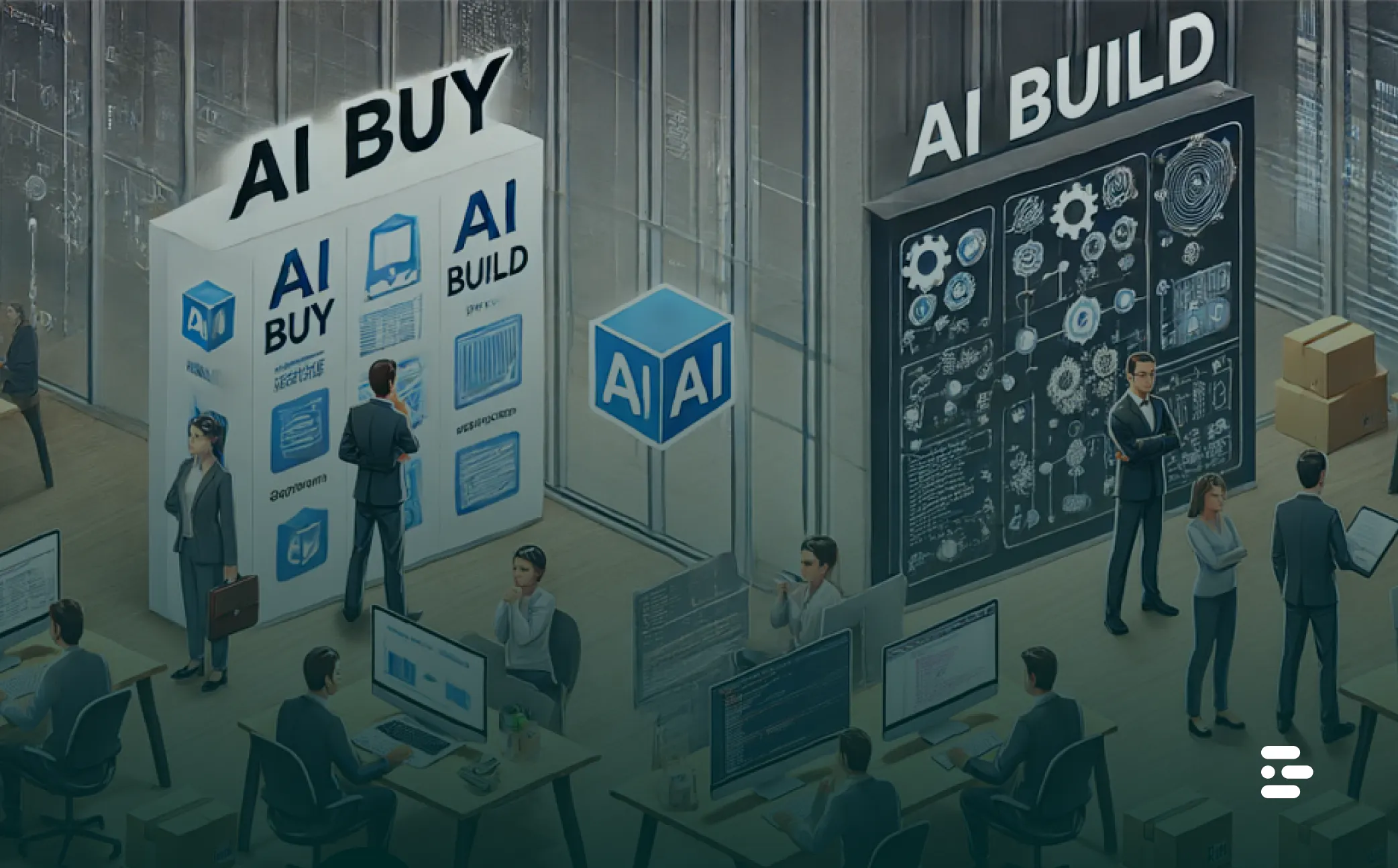

Historically, engineering executives balancing the "Build vs. Buy" equation wrestled with a relatively stable set of variables. Procuring a commercial SaaS solution meant accepting rigid vendor lock-in and compromised business logic, while building a proprietary platform required massive upfront capital, extended time-to-market, and a heavy internal maintenance burden.
The widespread integration of LLM-assisted coding workflows has violently distorted this traditional calculus. By drastically lowering the initial barrier to syntax creation, generative tools have created a dangerous executive illusion: that bespoke software is now perpetually cheap to create and own. For engineering leaders accountable for long-term platform resilience, navigating this new reality requires abandoning legacy procurement assumptions. The primary constraint on custom software development is no longer the human speed of writing code; it is the organizational capacity to govern its architectural impact.
The Deceptive Economics of Immediate Generation
Because the upfront friction of software development has plummeted, engineering organizations are defaulting to the "Build" path with unprecedented frequency. However, the initial capital saved on raw development hours is rapidly being transferred to the operational ledger.
When code generation accelerates without equivalent advances in architectural oversight, the boundary lines between bounded contexts degrade. According to McKinsey & Company’s analysis of developer productivity, while AI tooling expedites localized programming tasks by nearly 50%, it inadvertently introduces systemic bottlenecks by driving up codebase complexity and exponentially increasing the cognitive burden on downstream review cycles (McKinsey & Company, https://www.mckinsey.com/capabilities/mckinsey-digital/our-insights/unleashing-developer-productivity-with-generative-ai).
If an internal team chooses to build a custom platform utilizing generative tools without a hardened governance framework, they are not simply building an application. They are initiating a high-speed technical debt factory. Localized, machine-augmented decisions optimize for immediate functionality, frequently bypassing established data access layers or creating tight coupling between microservices. The organization bypasses the SaaS vendor, but the resulting bespoke system quickly solidifies into a compounding balance sheet liability.
Recalculating Total Cost of Ownership (TCO)
To make an accurate, risk-adjusted decision between building and buying today, the Total Cost of Ownership model must be fundamentally recalculated. The conventional TCO model assumes human-paced maintenance and predictable decay. AI-augmented development breaks this model by front-loading complexity.
The financial weight of unmanaged architecture is already staggering. Accenture’s Digital Core research reveals that existing technical debt drains approximately $2.41 trillion from the US economy annually, demanding massive resource reallocation just to keep lights on.
When evaluating the "Build" route in an AI-native environment, leadership must price in the cost of continuous structural validation. As Gartner projects that three-quarters of all enterprise software engineers will rely on AI assistants by 2028, the volume of generated syntax will soon outpace any manual review process. If the internal engineering organization lacks the automated infrastructure to security scan, architecturally validate, and structurally map every machine-generated commit, the decision to "Build" is functionally a decision to accumulate strategic drag.
The Third Capability: Sourcing Governed Execution
For complex enterprise ecosystems, the binary choice between purchasing an inflexible vendor product or shouldering the massive risk of an internal, AI-accelerated build is increasingly insufficient. The most resilient organizations are adopting a third path: procuring governed execution.
Rather than aggregating disparate developers or relying on commodity staff augmentation, this model leverages AI-Native Forward Deployed Engineering Teams. These specialized units operate as embedded strategic partners, taking ownership of the bespoke build while functioning entirely within strict, automated architectural guardrails.
This approach effectively neutralizes the primary liability of the modern "Build" scenario. By utilizing continuous system intelligence platforms—such as Velx—these teams treat all generated output as untrusted by default. Every feature, database migration, and API endpoint is validated against the enterprise’s target-state blueprint before it ever reaches a production branch.
Protecting the Custom Investment
Choosing to build proprietary software remains the ultimate lever for competitive differentiation. It allows an enterprise to own its intellectual property, customize workflows down to the deepest operational requirement, and avoid the homogenization of off-the-shelf SaaS.
However, protecting that investment in the current technological climate requires enforcing structure before speed. Sourcing an engineering partner capable of deploying highly aligned, governed development pods allows the enterprise to retain the bespoke advantages of custom software while completely offloading the architectural validation burden. The organization secures its tailored platform without absorbing the risk of unmanaged complexity.
Conclusion
The proliferation of agentic and generative coding tools has permanently altered enterprise software procurement. It is mathematically easier to build software today than at any point in history, but it has never been more difficult to keep those systems structurally sound.
Engineering leadership must acknowledge that the core variable in the Build vs. Buy calculus has shifted from creation to control. Organizations that successfully navigate this era will be those that stop measuring engineering success by generation velocity, and start measuring it by their capacity to enforce strict architectural discipline at scale.
Subscribe to our newsletter
Stay informed with the latest insights and trends in the industry