Building a Dynamic System of Record for Legacy Logic

Technical debt carries a substantial cost. This "tax" on existing technology estates accounts for 40% of IT balance sheets, and a significant portion—10% to 20%—of new product development funds is diverted to addressing technical debt issues. Furthermore, the report highlights the critical impact on IT delivery: CIOs burdened with high technical debt face considerably higher integration costs and a 50% decrease in delivery velocity.
These figures do not describe a problem of engineering capability; they describe a problem of information asymmetry. The friction in modernization initiatives, specifically the gap between the intent to modernize and the execution of that modernization, stems from the inability to accurately assess the current state. When 40 percent of an estate consists of "dark debt," the primary obstacle to migration is not the complexity of the target architecture, but the opacity of the source.
Organizations frequently attempt to bridge this gap through manual discovery or documentation audits. These methods invariably fail because they rely on static artifacts to describe dynamic systems. To mitigate risk effectively, the enterprise must shift from viewing assessment as a procedural audit to viewing it as the construction of a Dynamic System of Record. This asset serves as the single source of truth for business logic, derived not from human interpretation, but directly from the compiled reality of the codebase.
The Latency of Static Documentation
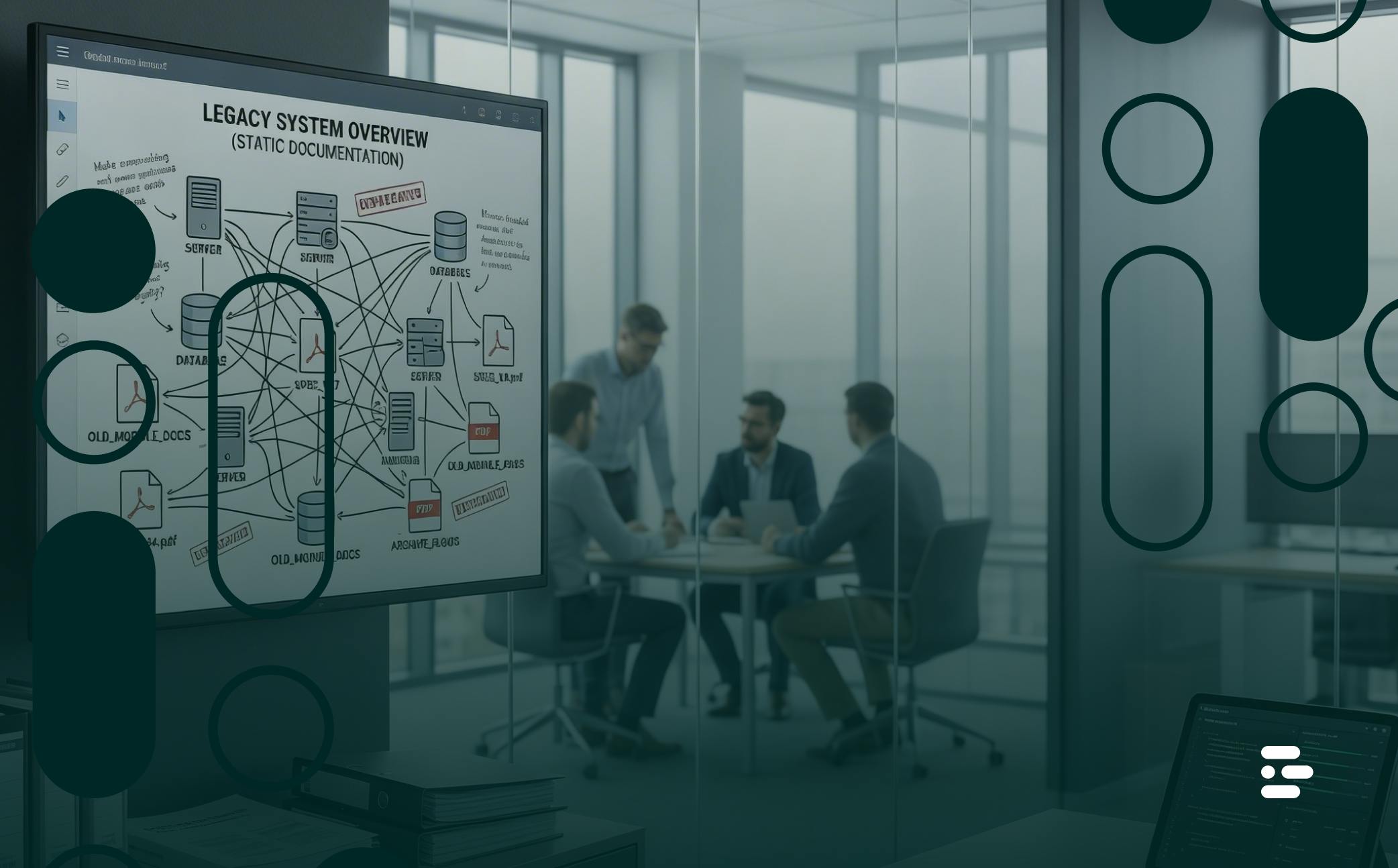
The central failure mode of traditional discovery phases is the reliance on human-generated documentation. In complex enterprise environments, the moment documentation is written, it begins to degrade. Code changes occur daily; documentation updates occur cyclically, if at all. This creates a divergence between the described system (the map) and the actual system (the territory).
This divergence is not merely an inconvenience; it is a source of catastrophic risk during modernization. When architects base migration strategies on documentation that is 90% accurate, the remaining 10%—often edge cases, error handling, and unmapped dependencies—causes the critical failures during production cutovers.
A Dynamic System of Record eliminates this latency. It does not exist as a separate document but as a live, queryable model generated from the Abstract Syntax Trees (AST) and Control Flow Graphs (CFG) of the source code itself. By treating the code as the only valid data source, the organization establishes a baseline that is mathematically consistent with the application's behavior.
Criteria for a Dynamic System of Record
Establishing this system requires specific evaluation criteria. The assessment mechanism must be capable of more than simple inventory or static code analysis (SCA). While SCA tools identify syntax errors or security vulnerabilities, they rarely illuminate intent. A functional System of Record requires the extraction of logic, not just the identification of syntax.
To serve as a viable bridge to modernization, the assessment framework must satisfy three structural requirements:
1. Deterministic Dependency Mapping
Most modernization efforts fail due to unmapped dependencies—the "unknown unknowns." A System of Record must provide a deterministic map of how data flows through the system. This goes beyond identifying that Module A calls Module B. It requires data lineage tracing: understanding how a variable originates in a database schema, is mutated by a specific Cobol copybook or Java class, and is eventually rendered in a UI or passed to an API.
If the assessment tool cannot visualize the "blast radius" of a specific logic change, it does not qualify as a System of Record. The output must allow an architect to query a specific database column and immediately visualize every line of code, across every application layer, that interacts with that data.
2. Business Rule Extraction vs. Code Translation
A common error in the consideration phase is conflating code translation with logic extraction. Converting legacy syntax (e.g., COBOL) directly into modern syntax (e.g., Java) without understanding the underlying business rule preserves the technical debt in a new language.
The System of Record must isolate the business rule from the implementation detail.
- Implementation Detail: A GOTO statement or a specific memory management routine.
- Business Rule: "If the customer account is > 5 years old and balance > $10,000, apply discount rate B."
The assessment phase must yield a catalog of these business rules in a format that is readable by business analysts, independent of the programming language. This separation allows the organization to decide which rules to migrate, which to retire, and which to optimize, rather than blindly lifting and shifting the entire codebase.
3. Cyclomatic Complexity and Risk Scoring
Not all code requires the same level of rigorous modernization. A System of Record must provide objective metrics on the complexity and stability of different modules. By calculating cyclomatic complexity (the number of linearly independent paths through a program's source code), the assessment identifies "hotspots"—areas of the code that are disproportionately complex and likely to contain bugs.
This data allows for a tiered modernization strategy. High-risk, high-value modules can be targeted for complete refactoring, while low-risk, low-complexity modules might be suitable for automated transpilation or encapsulation. Without this quantitative scoring, resource allocation during the project becomes speculative.
The Assessment as a Capital Asset
Historically, the discovery or assessment phase is viewed as "sunk cost"—a necessary administrative hurdle before the "real work" of coding begins. This perspective is flawed.
When an organization builds a Dynamic System of Record, it creates a capital asset. This asset has utility independent of the migration itself. It provides immediate value in the form of:
- Compliance Auditing: The ability to prove exactly how data is processed for regulatory purposes.
- Onboarding Efficiency: Reducing the time it takes for new developers to understand the legacy environment.
- Operational Stability: accelerating root cause analysis during incidents by visualizing dependencies.
Therefore, the investment in this deep-dive assessment is not project overhead; it is infrastructure investment. It converts the "dark debt" of the legacy estate into visible, manageable inventory.
Modernization as an Information Challenge
The decision to modernize is often framed as a technology choice, Cloud vs. On-prem, Microservices vs. Monolith. However, the success of the execution depends almost entirely on information fidelity. The organizations that succeed are not necessarily those with the best target architecture, but those with the most accurate understanding of their starting point.
By prioritizing the creation of a Dynamic System of Record, leadership moves the organization from a state of intuition-based planning to data-driven execution. The code contains the truth of the business operations; the challenge is solely in extracting that truth into a format that permits analysis. Once this visibility is achieved, the path forward ceases to be a venture into the unknown and becomes a calculated engineering exercise.
From Theory to Execution
The efficacy of a Dynamic System of Record is not theoretical; it is the primary differentiator between stalled initiatives and successful deployments.
When Banco Internacional confronted an estate of 115 interconnected, undocumented legacy applications, reliance on manual discovery was projected to consume months of engineering capacity. By utilizing automated discovery to establish a baseline of truth, the bank isolated 1,900 functional files from 3,500 candidates in less than one week.
This data-first approach did not merely update their documentation; it resulted in a 90% reduction in analysis time and a 40% reduction in implementation timelines, allowing them to modernize critical transaction systems without operational disruption.
To understand how a verified System of Record translates into modernization velocity, examine the complete architectural breakdown below.
Read the Case Study: Banco Internacional: From Legacy Infrastructure to Digital Market Leader
Subscribe to our newsletter
Stay informed with the latest insights and trends in the industry
You may also like