
BLOG
How AI-Assisted Engineering Is Changing Time-to-Market Benchmarks

Release frequency, cycle time, and lead time for changes became the language through which boards, executives, and product leaders evaluated delivery performance. Over time, these benchmarks stabilized, not because they were perfect, but because they reflected the constraints of how software was built.
AI-assisted engineering fundamentally shifts the dynamics of software delivery, going beyond simple task acceleration. It directly impacts where time is invested, how decisions are reached, and the points of friction within the entire system. This profound change means that many traditional time-to-market benchmarks are losing their relevance as reliable metrics of true delivery performance.
Speed is now gauged by the organization's ability to effectively absorb and manage increased velocity.
Time-to-Market Has Always Been an Organizational Outcome
Systemic issues were the primary cause of delivery slowdowns even before the advent of AI. While incorporating improved tools offered some benefit, even top-performing teams would eventually hit a ceiling due to dominant factors like coordination overhead, necessary rework, and decision-making delays.
AI-assisted engineering offers a solution to the growing divide between organizational activity and tangible outcomes. The pace of execution often outstrips an organization's ability to adapt its structure, leading to a visible gap. The primary limits on delivery speed are less about individual productivity and more about systemic issues:
- Cross-team dependencies
- Unclear ownership and escalation paths
- Slow or fragmented decision-making
Where AI Meaningfully Compresses Time
AI's impact on the delivery lifecycle isn't a uniform time reduction; instead, it most significantly affects areas where historical effort was heavily consumed by ambiguity and subsequent rework.
Earlier convergence, not endless iteration
Upstream, AI supports faster clarification of requirements, exploration of design alternatives, and early identification of risk. This leads to fewer late-stage reversals.
Faster feedback, not rushed releases
Downstream, AI-assisted testing, analysis, and review shorten feedback loops. Issues surface earlier, when they are cheaper to address.
According to Gartner, AI tools deliver the greatest time-to-market impact when they reduce handoffs and rework across the delivery flow, rather than when they are evaluated purely as coding accelerators.
Why Familiar Benchmarks Start to Lose Precision
As AI assistance becomes a standard part of engineering, the utility of traditional metrics for measuring speed is diminishing.
Specifically:
- Cycle time is less clear because decisions are often revisited in a non-linear fashion.
- Release frequency is misleading since the scope and certainty of releases are no longer uniform.
- Velocity metrics can be deceptively high, reflecting increased output without necessarily indicating a reduction in system friction.
Organizations must adjust their interpretation of "speed" when integrating AI across their development process to avoid mistaking sheer activity for genuine progress.
The emphasis is shifting from the importance of speed itself to the actual source of delay. This indicates that achieving sustainable speed now relies less on execution capacity and more on how engineering leaders structure decision-making and accountability across the organization.
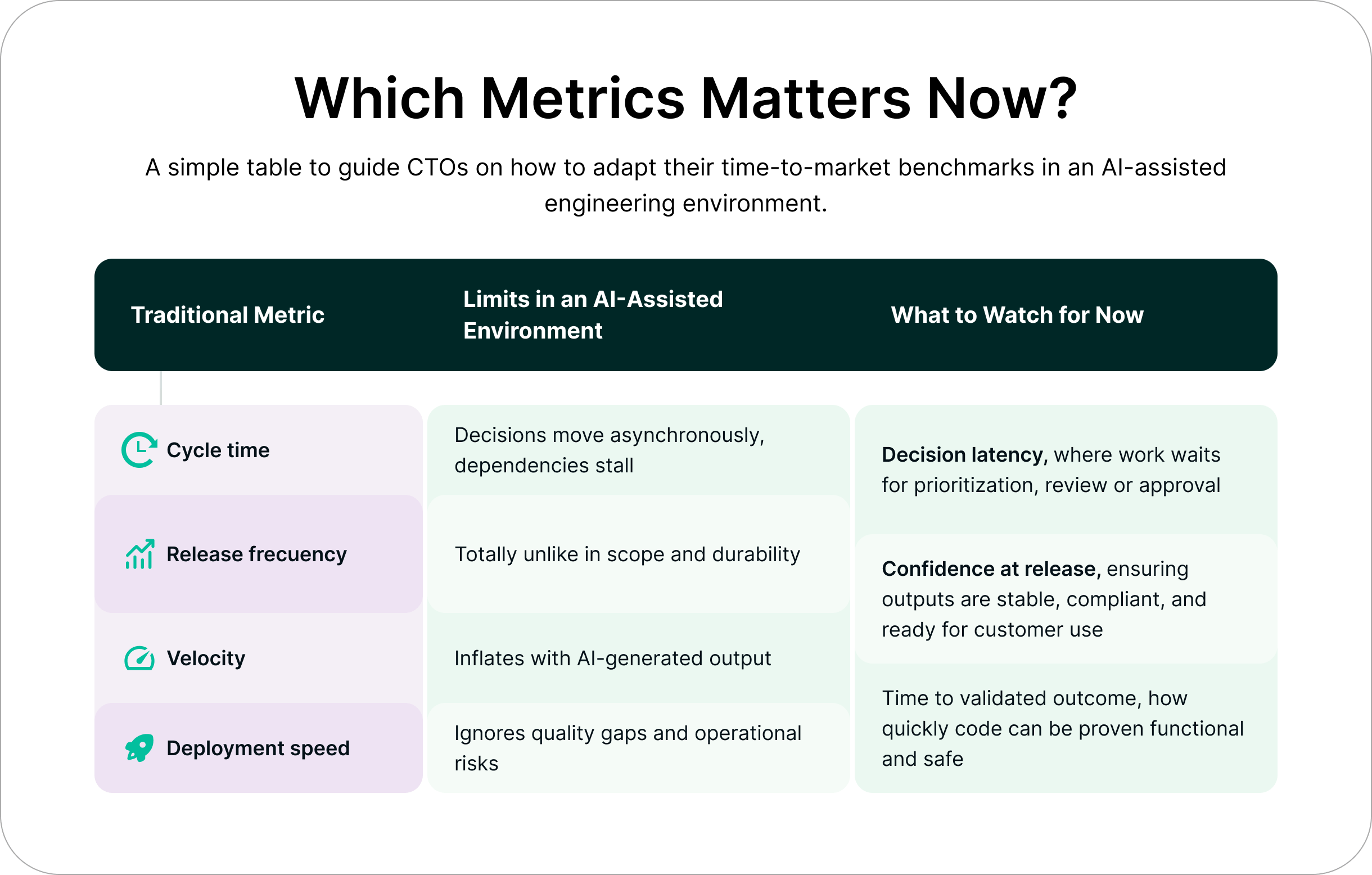
With AI accelerating execution, engineering leaders must re-evaluate which delivery indicators truly signify progress.
These changing signals highlight that sustainable speed now depends less on execution capacity and more on how engineering leaders design decision-making and accountability at scale.Achieving sustainable speed requires engineering leaders to focus on structuring decision-making and accountability processes at scale, moving beyond a focus solely on sheer execution capacity.
The Emerging Constraint Leaders Often Miss, Confidence
AI-assisted systems inherently introduce uncertainty through probabilistic outcomes, evolving outputs, and less predictable failure modes. When organizations lack trust in these systems, they often resort to familiar compensatory measures:
- Implementing extra manual reviews
- Adding informal layers of approval
- Slowing down release decisions, even after faster development
Consequently, while individual teams accelerate their work, the overall delivery process decelerates.
To counter this, high-performing organizations prioritize clarity alongside speed. They achieve this by investing in strong validation mechanisms, clearly defined ownership, and explicit decision rights, ensuring that faster execution does not compromise system reliability.
Recap and Closing
By 2026, AI will make tool access irrelevant for competitive advantage in engineering. Success will instead depend on an organization's skill in accurately measuring and managing speed within this AI-enhanced environment.
Leaders must shift focus to organizational friction by asking:
- Where is the work stalling despite rapid execution?
- What causes rework?
- What uncertainties delay decisions even after code completion?
AI-assisted engineering fundamentally shifts the measure of speed in software delivery. By accelerating execution, it reveals that the true constraint on time-to-market is the pace of making, validating, and committing to decisions, not simply the velocity of writing code.
Consequently, the goal is to redefine benchmarks. A successful approach focuses on clarity, confidence, and system throughput, moving beyond the aim of mere indiscriminate acceleration. Organizations that embrace this perspective will achieve faster, yet more sustainable, delivery outcomes, even as system complexity continues to increase.
Continue reading: Deliver Exceptional Software on a Budget: Smart Strategies for Cost-Effective Development


