
BLOG
The Capacity Playbook: How Engineering Leaders Stabilize Delivery Velocity

As engineering leaders, we face a universal truth: the product roadmap always expands faster than our internal capacity.
When critical roles are vacant, delivery slows down, and the pressure lands squarely on our shoulders, and on our best people. At the same time, we need to protect velocity, team health, and our credibility with the executive team.
This guide outlines the three non-negotiable levers we must pull to stabilize delivery velocity, offering practical, experience-based tips on when to use internal resources, when to cut scope, and when to strategically add external capacity.
The Cost of Waiting: Why Delay Is Not Free
Before we look at solutions, we must internalize the true cost of project slippage. It’s far worse than a missed deadline:
- Erosion of Trust: Every missed commitment weakens the product organization’s trust in engineering, leading to more planning overhead and skepticism in future timelines.
- Burnout is Contagious: When a team absorbs the work of an unfilled senior role, those developers enter a cycle of reduced code quality and increased stress. Studies show compressed deadlines correlate with decreased code quality and higher churn risk.
- The Velocity Tax: An open senior role is a velocity hole. The longer it's open, the greater the intangible cost in stalled initiatives and technical debt that piles up on the backlog.
The Three Levers: A Tactical Approach to Capacity Gaps
When the roadmap is at risk, a seasoned leader analyze the situation and apply the right mix of three core levers:
Lever 1: Internal Optimization & Reallocation (The Immediate Fix)
This is the fastest lever to pull because it requires zero outside approvals. It’s about creating "white space" within your existing team.
Actionable Tips for Internal Optimization:
- Aggressively Prune Meetings: Conduct a "meeting audit." Eliminate all non-critical check-ins and reduce planning sessions by 25%. Freeing up 3-5 hours a week per senior developer can stabilize a sprint.
- Cross-Train, Don't Divert: If a squad needs temporary QA or DevOps help, reallocate internal engineers for cross-training, not just task dumping. This builds resiliency for the future and prevents a complete dependency on one person.
- Minimize Context Switching: For critical path delivery, assign 100% focus. If an engineer is needed to unblock a dependency, temporarily pause their other 1-2 minor tasks. Context switching kills productivity.
Lever 2: Aggressive Scope Reduction (The Hard Reset)
This is the most painful lever, but often the most effective. It requires tough conversations with Product and Leadership.
Actionable Tips for Scope Reduction:
- Define and Defend the MVP: Use the gap in capacity to force a hard look at the scope. Identify and eliminate non-critical features planned for the next two quarters. If it doesn't solve a core business problem or user need, it goes.
- Freeze Non-Urgent Technical Debt: While dangerous long-term, temporarily freezing minor refactoring or non-critical debt reduction to focus purely on feature delivery can buy a team 1-2 sprints of capacity.
- Improve Product/Engineering Alignment: Use the capacity crunch as leverage to improve estimation. Standardize sizing across squads to prevent ambitious scope creep from product managers.
Lever 3: Strategic External Capacity (The Scalable Solution)
When you've optimized internally (Lever 1) and cut scope to the bone (Lever 2), and you still can't deliver, external capacity is the only path forward. This is where staff augmentation is treated not as "outsourcing," but as a strategic, on-demand tool for capacity expansion.
Actionable Tips for External Capacity:
- Identify the Niche/Senior Gap: Don't augment generalists. Augment specific, high-leverage roles like Senior DevOps, QA Automation, or specialized back-end skills that your team lacks or can't hire fast enough.
- Demand a Proven Ramp-Up Plan: The single biggest risk in augmentation is time-to-value (onboarding drag). Any external partner must show how they beat the 4-6 week industry average for knowledge transfer. A modern engineering partner uses AI-native tools to map your codebase, dependencies, and architecture before their engineer even starts, cutting ramp-up time from weeks to days. This AI-accelerated onboarding is non-negotiable.
- Ensure Cultural Integration: The external resource must report to your engineering managers, attend your standups, and write code to your standards. They must feel like part of the team, not just contractors.
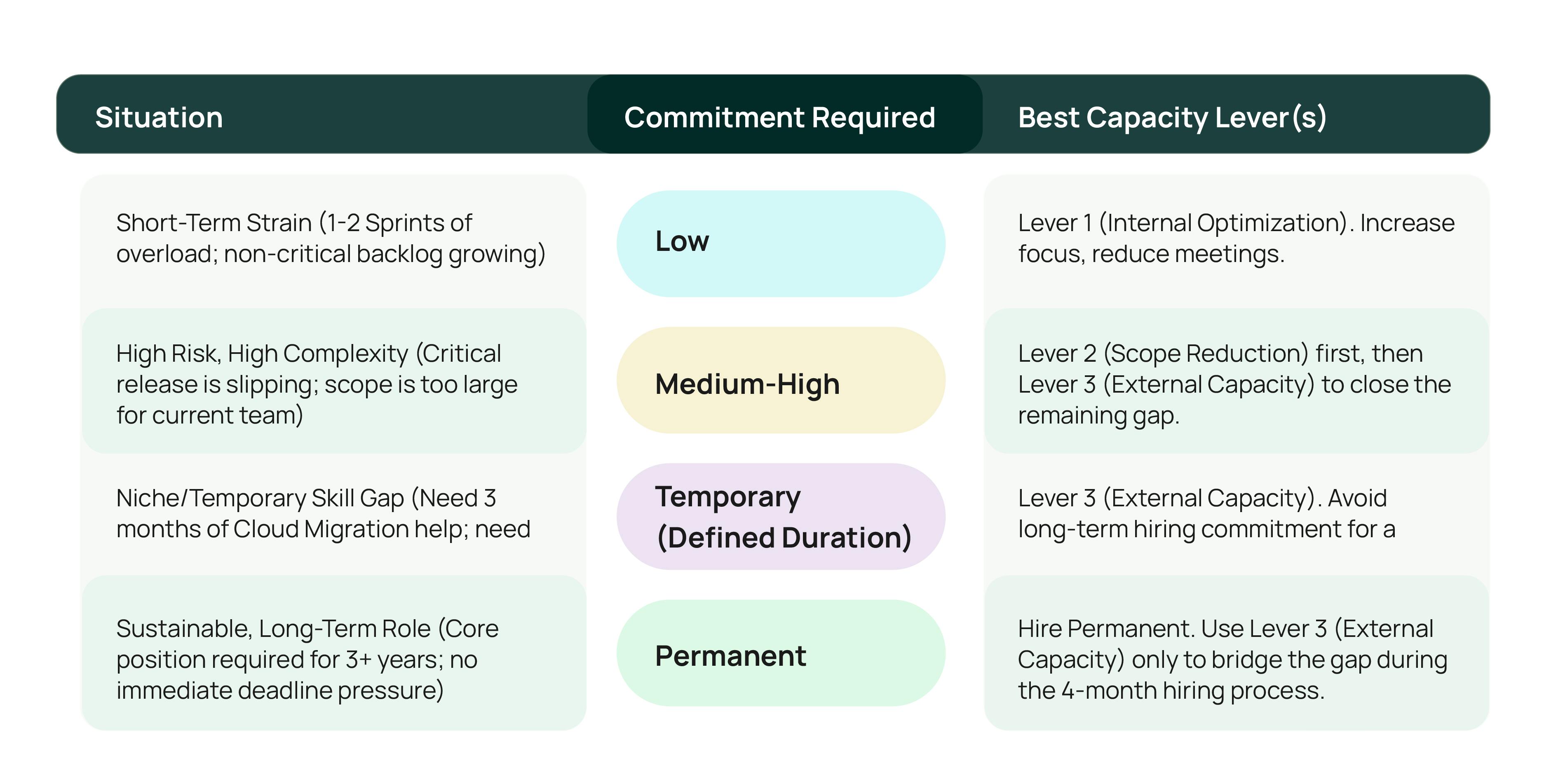
The Decision Framework: Which Lever to Pull Now?
Use this framework to evaluate the urgency and required commitment of your capacity gap:
Practical Steps to Implementing a Capacity Stabilization Plan
- Audit the Critical Path: Pinpoint where slippage risk is highest. Is it an upcoming release? Infrastructure? Performance tasks?
- Execute Levers 1 & 2: Before talking to vendors, run the internal optimization (meetings, focus) and scope reduction (cut the fluff). Only then calculate the residual capacity gap.
- Define the Skill and Speed Requirements: Be explicit about the role (senior backend, mobile, etc.) and, most importantly, demand a rapid time-to-value commitment from any external partner.
- Monitor and Measure Outcomes: Track team bandwidth, delivery velocity, and code quality. The goal is predictable performance, not just activity.
Final Thoughts
The greatest skill of an engineering leader is its capacity management. Waiting for headcount approval and enduring a lengthy, high-risk hiring cycle is no longer a viable strategy for high-growth companies.
Mastering internal optimization combined with strategic, AI-accelerated external capacity when necessary allows us to stabilize our roadmaps, protect our teams, and maintain the velocity that drives business success.
We invite you to keep reading the The Ultimate Checklist For Evaluating Nearshore Software Development Partners.


