How Enterprises Are Rethinking Legacy Modernization to Keep Pace With the Industry

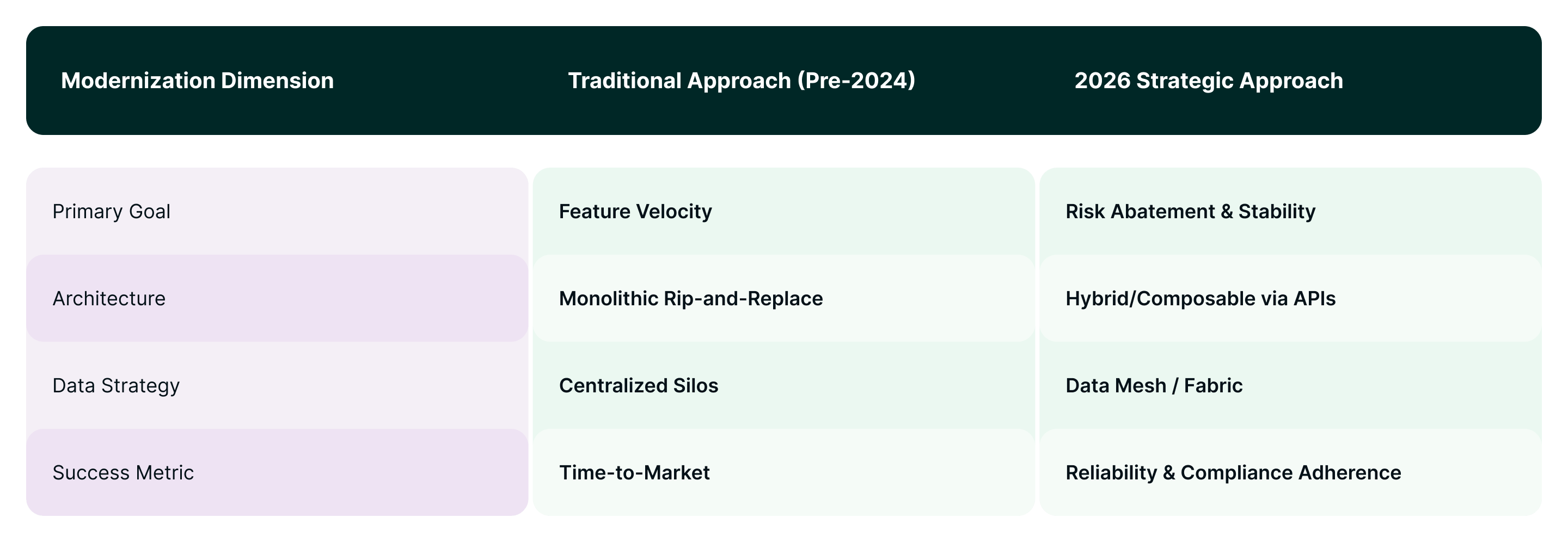
In the current landscape of 2026, the industrial consensus on legacy modernization has fundamentally shifted from a narrative of replacement to one of calculated resilience. 80% of organizations have shifted their modernization strategy in the last year alone, moving away from "big-bang" replacements toward iterative, hybrid models. This pivot is driven by the reality that while the strategic importance of legacy mainframes is often publicly downplayed, 56% of enterprises have actually increased their platform usage to maintain stability in an increasingly volatile market
For engineering leadership in compliance-heavy sectors, the objective is no longer to "digitize" the enterprise, that mandate was settled years ago. The current challenge is managing the $370 million in annual maintenance and lost opportunity costs that Deloitte and IT Pro attribute to legacy friction. Success in 2026 is measured by the ability to introduce change without compromising the five-nines of stability that mission-critical systems require.
The Regression of the "Big Bang" Narrative
The industry has entered a "Year of Reckoning" for enterprise applications. McKinsey and Gartner report that approximately 70% of digital transformation initiatives still fail to meet their primary objectives, often due to a lack of strategic alignment or the underestimation of system complexity. These failures represent millions in sunk capital and months of operational paralysis.
The primary cause-and-effect relationship observed in failed modernizations is the attempt to decouple tightly integrated monolithic systems without first establishing a System of Record for the logic itself. Many legacy systems in fintech are effectively undocumented, their business rules living only in the execution of COBOL or early Java routines. Attempting a total rewrite introduces a high probability of logic regression.
Modern leaders are therefore opting for a "Strangler Fig" approach, where new functionality is built in microservices or modules that sit alongside the legacy core, gradually assuming its responsibilities.
This method prioritizes certainty before execution. By intercepting specific calls and routing them to modernized components, organizations can validate the performance of new logic in production-adjacent environments before decommissioning legacy paths.
Decoupling as an Operational Risk Strategy
In 2026, the trend of API-First architecture has matured from a design preference to a mandatory risk-management framework. 82% of businesses have adopted an API-first approach, with 25% operating as fully API-first organizations.
For highly regulated entities, the API layer acts as a "compliance buffer." Instead of allowing external vendors or internal innovation teams direct access to the mainframe or core database, the API layer enforces governance, logging, and security protocols (such as Zero Trust) at the perimeter. This architectural choice addresses several constraints:
- Fragile Monoliths: APIs allow for the modernization of the "User Experience" or "Data Analytics" layer without touching the "Transaction Processing" core.
- System Opacity: By mapping the existing system’s inputs and outputs via APIs, teams create a de facto documentation of how the system interacts with the outside world.
- Talent Scarcity: As the pool of legacy experts shrinks, the API layer allows modern full-stack engineers to interact with the system using familiar protocols, reducing the need for direct legacy code manipulation
The Role of Domain-Specific Intelligence
The hype surrounding General-Purpose AI (LLMs) has given way to a more disciplined use of Domain-Specific Language Models (DSLMs). Gartner predicts that by 2028, over 50% of the GenAI models used by enterprises will be domain-specific, trained or fine-tuned on specialized industry data.
For the engineering leadership, AI is not merely a tool for mass code generation, a practice that frequently introduces a subsequent layer of technical debt. Rather, AI is being deployed as a force amplifier for system discovery. Specifically, enterprises are leveraging AI-native development platforms for the following:
- Dependency Mapping: AI can analyze millions of lines of undocumented code to map the connections between modules, identifying "dead code" or high-risk coupling points that would take human auditors months to find.
- Logic Extraction: Translating legacy business rules into human-readable specifications, which then serve as the blueprint for modernized services.
- Automated Testing Regimes: Generating regression tests that ensure parity between the legacy output and the modernized output under a wide variety of edge cases.
This application of AI reduces "blind spots." It is a tool for understanding the system before changing it, directly addressing the skepticism toward AI-generated code by focusing the technology on analysis and verification rather than unvetted creation.
Compliance as the Architect of Modernization
Modernization is increasingly a response to the evolving regulatory landscape. The GENIUS Act (July 2025) and upcoming federal banking regulations expected by July 2026 have made "Compliance-by-Design" a technical requirement.
Regulators now require a level of data lineage and transparency that many legacy systems are simply unable to provide. When a system cannot document the origin of every training record or the exact path of a transaction through its disparate modules, it becomes a liability.
Modernization is thus being reframed as the process of moving workloads to Confidential Computing environments. More than 75% of workloads on untrusted infrastructure will utilize confidential computing to isolate sensitive data during processing.
This means that the cloud migration strategy has become more about "security-first data sovereignty." Hybrid architectures, where 90% of organizations are expected to operate through 2027, allow for the most sensitive transaction logic to remain on-premise while leveraging cloud-native security platforms to manage the perimeter.
Moving Toward Continuous Modernization
The industry has moved past the era of the transformation project with a defined start and end date. Modernization is now viewed as a continuous operational state, a Modernization Loop where systems are constantly being refactored, decoupled, and optimized.
The primary responsibility of engineering leadership has shifted from delivering a new system to maintaining the evolutionary fitness of the existing one. This requires a cultural shift away from rewarding the launch of new features and toward rewarding the reduction of technical debt and the improvement of system observability.
As we look toward 2027, the organizations that will successfully keep pace with the industry are those that acknowledge the complexity of their legacy foundations rather than attempting to bypass them. Success is found in the incremental, the analytical, and the risk-aware. By leveraging domain-specific AI for discovery and adopting a hybrid, API-first architecture for execution, enterprises can protect their production stability while ensuring they are not left behind by the rapid pace of technological change.
Conclusion: Embracing Continuous Modernization
The industry consensus has pivoted from a narrative of replacement to one of calculated, risk-aware evolution. Successful enterprises are integrating incremental change and analytical certainty into their core operational strategy.
- Pivoting to Hybrid Architectures: "Big-bang" replacements are regressing. Modern strategy favors the "Strangler Fig" approach, using API-first architecture as a mandatory risk-management framework to decouple fragile monoliths.
- AI as a Force Amplifier for Discovery: General-Purpose AI has been disciplined into Domain-Specific Language Models (DSLMs) used for system discovery—mapping dependencies and extracting business logic—to reduce blind spots before code creation.
- Modernization as a Compliance Imperative: Evolving regulations like the GENIUS Act make "Compliance-by-Design" a technical requirement, shifting workloads to Confidential Computing and security-first hybrid architectures.
Dive deeper into the foundational challenge of undocumented systems and how to build the crucial System of Record for the logic itself.
Read next: The Risk of Invisible Debt: System Mapping in the Age of Technical Fragility
Subscribe to our newsletter
Stay informed with the latest insights and trends in the industry
You may also like