BLOG
The 30-Day 'Proof of Value': How to Structure a Low-Risk Pilot for Legacy Modernization

Through 2027, the failure rate for large-scale digital transformation initiatives will remain as high as 75%, often due to an inability to align technical execution with tangible business outcomes. For CTOs and VPs of Engineering, this statistic represents more than just a missed KPI; it reflects the systemic risk of "Big Bang" modernization efforts that consume capital for 12 to 18 months before delivering a single production-ready feature.
The main obstacle to modernization isn't a lack of foresight, but the inherent "Analysis Paralysis" that high-stakes uncertainty creates. When a legacy system overhaul seems overwhelming, projects often get stuck in endless planning because the return on investment (ROI) appears too far off. To overcome this, organizations need to change the focus from simply Modernizing the System to successfully Validating the Pattern.
The 30-Day Proof of Value (PoV) serves as this circuit breaker. Unlike a traditional Proof of Concept (PoC), which merely confirms that a specific technology functions in a vacuum, the PoV generates empirical data within the client’s unique environment. It is designed to prove functional parity, compliance adherence, and cost-predictability before a long-term commitment is ever signed.
Selecting the Thin Vertical Slice
Successful modernization follows the logic of the Strangler Fig pattern: incrementally replacing legacy functionality with new services until the old system is decommissioned. However, the first step in this transition is frequently the most miscalculated.
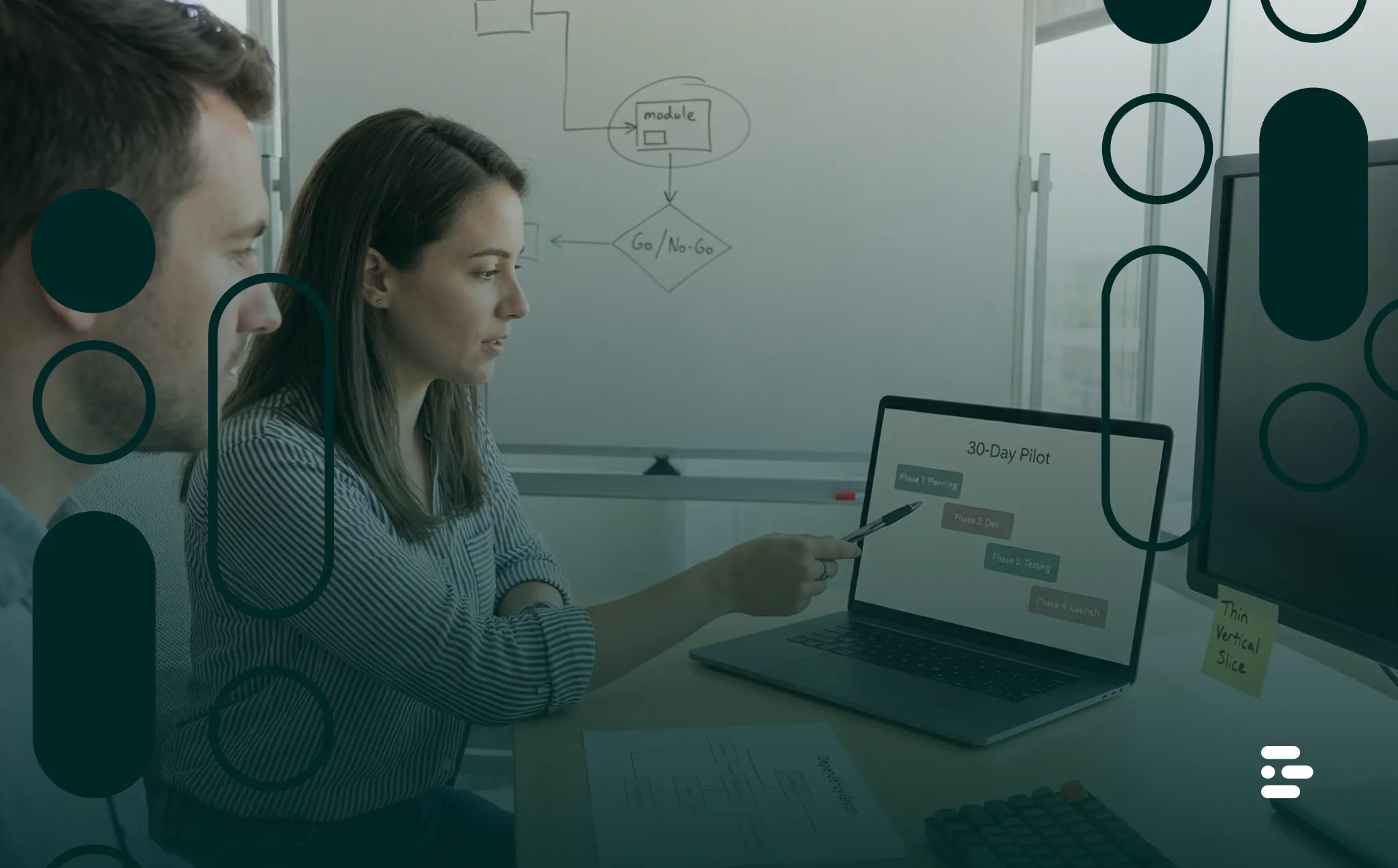
Modernization should not begin with the core transaction engine. Instead, the PoV targets a Thin Vertical Slice. This is a low-risk, isolated module, such as a notification service, a reporting export, or a specific API endpoint, that allows the team to test the entire deployment and integration pipeline without endangering the primary revenue stream.
Criteria for the Pilot Candidate:
- Defined Boundaries: The slice must have clear, measurable inputs and outputs.
- Data Layer Interaction: It must touch the legacy database to prove the team can manage data gravity and synchronization.
- Governance Testing: It should involve a compliance requirement (e.g., PII handling) to demonstrate that the new architecture survives enterprise-grade security gates.
The 4-Week Execution Roadmap: Powered by Velx
To condense months of architectural discovery into a 30-day window, Devsu utilizes Velx, our proprietary AI-native modernization engine. Velx transforms the pilot from a manual discovery exercise into a precision-engineered transition.
Week 1: Non-Invasive Discovery & Mapping
The initial phase avoids manual interviews, which are often subject to the "Institutional Memory Gap." Instead, we deploy Velx Explorer.
- Action: Perform automated static and dynamic analysis of the legacy codebase.
- Goal: Map the dependencies of the chosen "Slice."
- Deliverable: A Dependency Graph. This visualization reveals "Invisible Debt"—circular dependencies or undocumented calls—before a single line of code is touched.
Week 2: Compliance-First Architecture Setup
Modernization often fails due to "Bureaucratic Friction" rather than technical inability.
- Action: Establish a hybrid cloud or secure on-prem zone using Velx Architect blueprints.
- Goal: Configure CI/CD pipelines with automated compliance checks (linting for PII, security scanning).
- Deliverable: A "Hello World" Deployment that passes all enterprise security gates. This proves we can navigate your specific internal bureaucracy.
Week 3: The Code Modernization (The Strangler Test)
With the environment secured, the logic of the legacy slice is refactored into a modern, containerized service.
- Action: Utilize Velx Coder to refactor logic into a modern language while running in "Shadow Mode" to compare outputs.
- Goal: Ensure the new service replicates legacy behavior perfectly.
- Deliverable: A Parity Report. This document provides mathematical proof that Old_System_Output == New_System_Output.
Week 4: The Executive Business Case
The final week transitions from technical execution to financial forecasting.
- Action: Extrapolate data from the Velx-assisted migration.
- Goal: If it took $X and Y days to modernize this slice, we can now mathematically project the cost and timeline for the rest of the system with 80% higher accuracy than a standard RFP.
- Deliverable: A De-Risked Modernization Roadmap based on actual code metrics, not sales guesses.
The Go / No-Go Gate
The PoV concludes at a formal decision point. By design, this 30-day window limits the organization’s exposure, creating two distinct, low-pressure scenarios:
- Scenario A: The pilot fails to meet KPIs. The organization loses only 30 days of effort but gains invaluable data on why the current strategy is unfeasible. This prevents the "Sunk Cost Fallacy" from driving a multi-million dollar disaster.
- Scenario B: The pilot succeeds. The organization now possesses a Template for Scale—a battle-tested blueprint of CI/CD pipelines and refactoring patterns that can be replicated across the remaining modules.
Data Over Intuition
Legacy modernization is frequently treated as an "art", a subjective process of migration and hope. This perspective is the root cause of high failure rates. Modernization is more accurately viewed as a scientific process: a series of controlled experiments designed to reduce uncertainty.
The 30-day PoV, accelerated by Velx, replaces "vendor estimates" with architectural evidence. When a roadmap is built on a foundation of parity reports and dependency graphs, the transition is no longer a leap of faith; it is a calculated execution.
Secure Your Roadmap
Don't sign a transformation contract based on a presentation. Sign a pilot based on proof. Our team is ready to help you identify your first "Thin Vertical Slice" and demonstrate how Velx can accelerate your path to a modern stack.


