BLOG
VelX vs. Alternative AI Coding Tools: Choosing the Right AI Coding Partner for Software Delivery Solutions

Introduction: The Executive Dilemma
“Which AI coding solution aligns best with our business goals?”
As enterprises build new digital products and scale across hybrid environments, the stakes are higher than ever. AI tools now extend far beyond autocomplete. They’re becoming agents capable of transforming codebases, generating infrastructure, and accelerating delivery pipelines.
While well-known tools like GitHub Copilot, Google Gemini Code Assist, and Amazon Q Developer have gained attention, they were each designed with specific ecosystems in mind: GitHub/Microsoft, Google Cloud, and AWS. They improve developer productivity inside those walls, but often stop short of addressing what executives need most: supporting engineers in the delivery of new software products, accelerating enterprise transformation across multi-cloud environments, and modernizing complex legacy systems to reduce technical debt.
That’s where VelX stands apart. Unlike ecosystem-locked assistants, VelX was purpose-built to deliver end-to-end software strategies with human-in-the-loop validation, outcome-driven playbooks, and the flexibility to adapt across infrastructures. In this blog, we’ll show how VelX compares to Copilot, Gemini, and Q Developer across five critical dimensions, and why VelX emerges as the best choice for enterprises making strategic AI investments.
1. Agent Autonomy: From Autocomplete to Action
The first question executives ask: Can the tool go beyond suggesting snippets and actually handle tasks end-to-end?
- GitHub Copilot Enterprise
GitHub recently introduced the Copilot Coding Agent, which can be assigned GitHub Issues and will autonomously generate code changes, create a branch, commit updates, and open a pull request for human review. This elevates Copilot from a suggestion tool to an agent embedded directly in the GitHub workflow. - Google Gemini Code Assist
Gemini emphasizes interactive, context-aware code assistance inside IDEs. It provides inline code diffs in VS Code and JetBrains, allowing developers to accept or reject changes. While powerful, Gemini operates more as a conversational partner than an autonomous agent. - Amazon Q Developer
Q Developer markets itself as an agentic coding experience, capable of reading and writing files, generating code diffs, and running shell commands within IDEs. It functions as a multi-purpose assistant across the SDLC. - VelX
VelX takes a different approach: instead of raw autonomy, it delivers structured playbooks where AI and human experts collaborate. This balances automation with accountability, ensuring that new software projects remain auditable and aligned with business outcomes.
2. Software Delivery: Building What’s Next
The real opportunity of AI coding tools lies in accelerating the delivery of new products and applications. While it helps developers write code faster, it also enables organizations to bring ideas to market more efficiently, reduce delivery risks, and empower engineering teams to focus on innovation.
- GitHub Copilot Enterprise
Streamlines code writing within GitHub and IDEs, making engineers faster at implementing features. But it’s primarily a productivity tool, not a delivery framework. - Google Gemini Code Assist
Offers rich integration with Google Cloud services, which helps when building data-driven applications in GCP. Its delivery support is tied closely to the Google ecosystem. - Amazon Q Developer
Assists with infrastructure-as-code and service generation in AWS, making cloud-native delivery smoother. However, its scope is limited if teams operate outside AWS. - VelX
Goes beyond code completion. VelX supports full-cycle software delivery, from greenfield applications to new digital platforms, while ensuring that delivery aligns with architecture, compliance, and business outcomes. By combining automation with expert oversight, VelX enables organizations to confidently build what comes next.
3. Modernization Capabilities: Tackling Legacy Systems
For many organizations, the true bottleneck is updating old apps. Legacy systems drain budgets and block innovation. Which tool tackles this head-on?
- GitHub Copilot
Copilot shines in developer productivity but offers limited support for large-scale codebase transformation. Its focus is coding within active repos, not system-wide refactoring. - Google Gemini Code Assist
Gemini integrates deeply with Google Cloud services like Firebase, BigQuery, and Apigee. This makes it valuable for teams modernizing data pipelines or apps already in the GCP ecosystem. Its modernization impact, however, is indirect—focused more on editing than migration strategy. - Amazon Q Developer
This is Q Developer’s strongest differentiator. It supports legacy code remediation and runtime upgrades, such as migrating Java 8 apps to Java 17 . It also automates Infrastructure-as-Code (IaC) generation in CloudFormation, CDK, and Terraform. Even mainframe modernization is on the roadmap, with AI agents designed to decompose monoliths. - VelX
VelX was purpose-built for end-to-end modernization. It not only automates code transformation but also provides roadmaps for re-platforming architectures, migrating databases, and aligning modernization efforts with strategic KPIs. Unlike AWS, GCP, or GitHub tools, VelX is cloud-agnostic, designed for hybrid and multi-cloud realities.
4. Ecosystem Integration: Where Work Gets Done
Adoption depends on fit.: Does this tool live where my developers already work?
- GitHub Copilot
Works across GitHub.com, VS Code, JetBrains IDEs, and Visual Studio. This makes it seamless for organizations embedded in Microsoft/GitHub ecosystems. - Google Gemini Code Assist
Available in Cloud Shell Editor, Cloud Workstations, Firebase console, Colab Enterprise, and IDEs like VS Code/JetBrains . Its native integrations with Google Cloud services are a clear draw for GCP-first companies. - Amazon Q Developer
Integrates across the AWS Console, IDEs (VS Code), SageMaker, Slack, Teams, CodeCatalyst, and the AWS mobile console . It lives wherever AWS services are consumed, reinforcing its cloud-native alignment. - VelX
VelX is ecosystem-agnostic. It integrates into multiple developer environments and CI/CD pipelines, ensuring flexibility across GitHub, GitLab, Azure DevOps, AWS, and GCP. This makes VelX uniquely positioned for enterprises operating in multi-cloud or regulated industries.
4. Governance & Compliance: Scaling Without Risk
Executives care deeply about control, especially in regulated industries.
- GitHub Copilot Enterprise
Provides enterprise-level policy controls, auditability, and org-wide management settings . Leaders can enforce security and model usage rules across teams. - Google Gemini Code Assist Enterprise
Offers source citations, VPC-SC (Virtual Private Cloud Service Controls), and intellectual property indemnification . Enterprise buyers gain confidence that data stays protected. - Amazon Q Developer
Governance is still maturing, but AWS emphasizes secure context isolation and enterprise readiness. Its advantage lies in AWS’s global compliance certifications. - VelX
VelX builds governance into the core. Every new and/or old project includes human-in-the-loop validation, audit trails, and customizable compliance controls, ensuring transformations pass not just technical but also regulatory review.
5. Pricing & TCO Snapshot
Pricing signals help leaders estimate adoption costs:
- GitHub Copilot: $19/user/month (Business) or $39/user/month (Enterprise)
- Google Gemini Code Assist: $19/user/month (annual Standard), $22.80/user/month (monthly Standard), $45–54/user/month (Enterprise) (Gemini pricing).
- Amazon Q Developer: Free tier, with Pro at $19/user/month.
- VelX: Pricing is customized per organization, reflecting the complexity of each project and outcome-based engagement rather than flat per-seat costs.
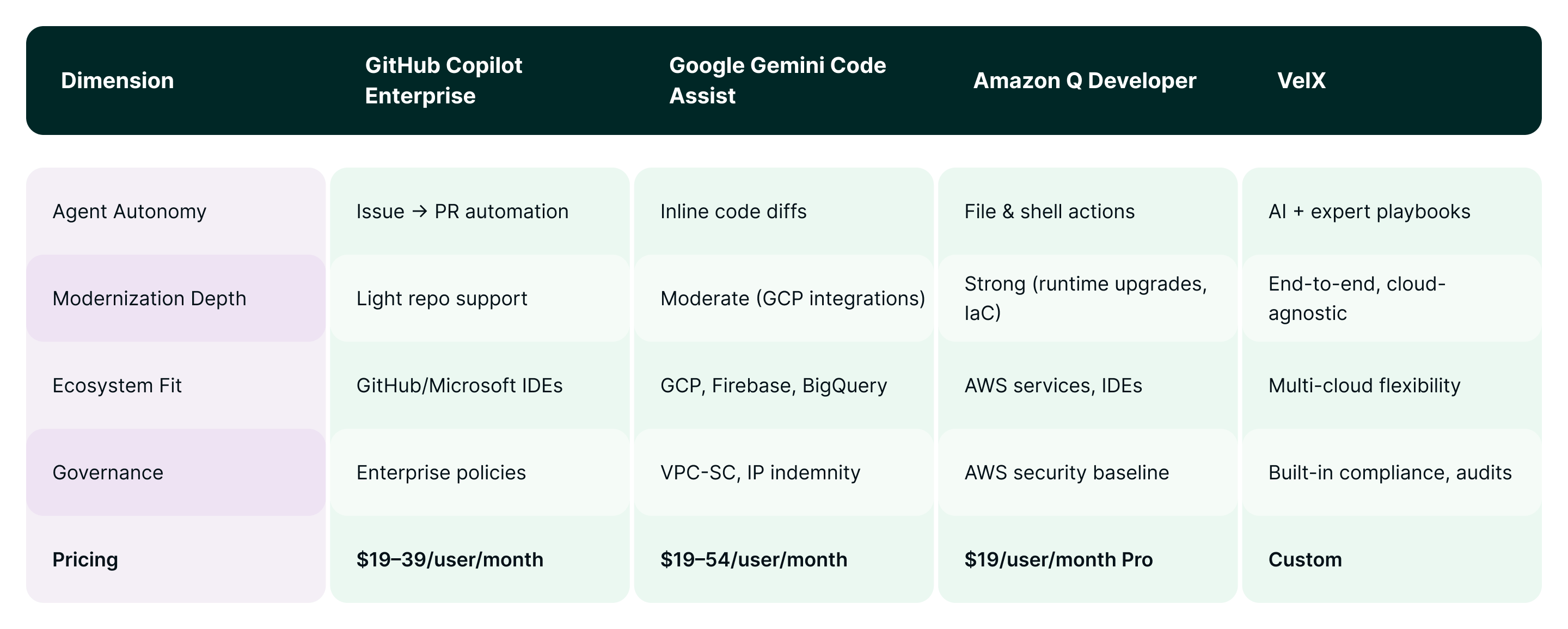
At-a-Glance Comparison
Conclusion: Choosing the Right Fit
- GitHub Copilot Enterprise is the natural choice if your org already runs on GitHub and Microsoft, with strong productivity and workflow integration.
- Google Gemini Code Assist shines for GCP-centric teams needing IDE integration with Google’s cloud data ecosystem.
- Amazon Q Developer is the modernization-first option for AWS shops, especially those with runtime upgrades and IaC needs.
But for organizations facing complex tech ideas, hybrid infrastructure, or compliance-driven mandates, VelX stands apart. It combines automation with human expertise, delivering end-to-end strategies that align with business outcomes, not just developer productivity.
Ready to see VelX in action? Explore this case study to learn how we helped a leading enterprise build projects with impact, accelerate delivery cycles, and unlock measurable ROI with VelX.


