
BLOG
Which AI Role Should You Hire First

Strategic Trade-offs Engineering Leaders Must Make Heading into 2026
With AI rapidly reshaping how software is built and products are delivered, engineering leaders in the US and Canada face a real challenge: which AI role should you hire first? As you push to scale teams and integrate AI responsibly, hiring decisions matter not just for capacity but for strategic leverage. The wrong first hire can create blind spots; the right one becomes a force multiplier.
Below we break down the top AI roles gaining traction for 2026, the strategic trade-offs behind prioritizing each, and the recommendations engineering leaders should consider when shaping their teams.
Real Market Signals: The AI Job Landscape
AI adoption in organizations continues to accelerate. Recent industry data shows that over half of organizations expect AI to augment 26%–50% of jobs by 2026, with developers and engineers increasingly using AI tools in daily workflows.
Meanwhile hiring platforms and job trend trackers consistently list AI engineer, machine learning engineer, data engineer, and other specialized AI roles among the top in-demand tech positions for 2025–2026.
These signals tell us AI roles are central to future competitive advantage and system reliability.
The Candidate Roles You’re Hearing About
Below are the primary AI roles most engineering organizations are considering first, ranked by strategic impact and the trade-offs that come with each decision.
1. AI/Machine Learning Engineer
What they do: Build, train, and deploy AI models, integrating them into products and services.
Why is it a strong first hire: These engineers accelerate product delivery and enable teams to ship intelligent features faster. According to market job data, roles labeled “AI engineer” are increasingly prevalent as organizations evolve their AI capabilities.
Trade-off: Hiring for deep technical model work can be costly and requires strong data and infrastructure support. Without strong data pipelines, your ML work will stall, so this role pairs tightly with data engineering capability.
2. Data Engineer / AI Infrastructure Specialist
What they do: Build the data foundations needed to train and maintain AI systems.
Why consider them first: A significant trend in the market warns against hiring AI specialists without strong data and infrastructure roles supporting them. Many AI initiatives fail because the underlying data is inaccessible or poorly governed.
Trade-off: If you hire data engineers first, you may delay visible feature progress. But strong data foundations reduce AI project failure risk and make future hires exponentially more productive.
3. AI Product Manager / AI Strategy Lead
What they do: Connect business goals with AI capabilities, define AI use cases, and guide prioritization.
Why strong first hire: As organizations integrate AI from the experimental phase into core products, there is a crucial need for leaders who can connect business objectives with technological execution. The AI Product Manager fills this role, guaranteeing that development teams focus on solving the correct problems rather than simply creating complex models.
Trade-off: This role is less technical, and if hired too early, can feel disconnected without engineers in place. The best time to hire this role is when you already have some technical momentum.
4. AI Governance, Ethics, and Risk Specialist
What they do: Ensure AI systems are safe, compliant, and aligned with organizational and industry policies.
Why this matters now: Industry insight shows a shift toward roles focused on system-level thinking and governance. Responsible AI practices are infrastructure concerns, not compliance afterthoughts.
Trade-off: Governance roles often don’t deliver immediate product features. Their value is derived from risk reduction and long-term reliability, which is indispensable as AI becomes increasingly integrated into core products.
5. Forward-Deployed Engineer (FDE)
What they do: Blend technical execution with customer and product understanding to tailor AI systems in real use contexts.
Why this could be first: A new breed of role gaining traction, particularly in AI-centric organizations, is forward-deployed engineering, where developers work directly with business units or customers to drive AI adoption and feedback loops.
Trade-off: FDEs are rare and expensive. They are an excellent accelerant when used strategically, but may not make sense for early-stage internal AI practices.
AI Roles Demand Snapshot for 2026
The table below works as a semaphore-style view for engineering leaders. It helps quickly assess market demand, urgency, and strategic timing when deciding which AI role to prioritize first.
AI Roles Demand and Priority Matrix (US & Canada Focus)
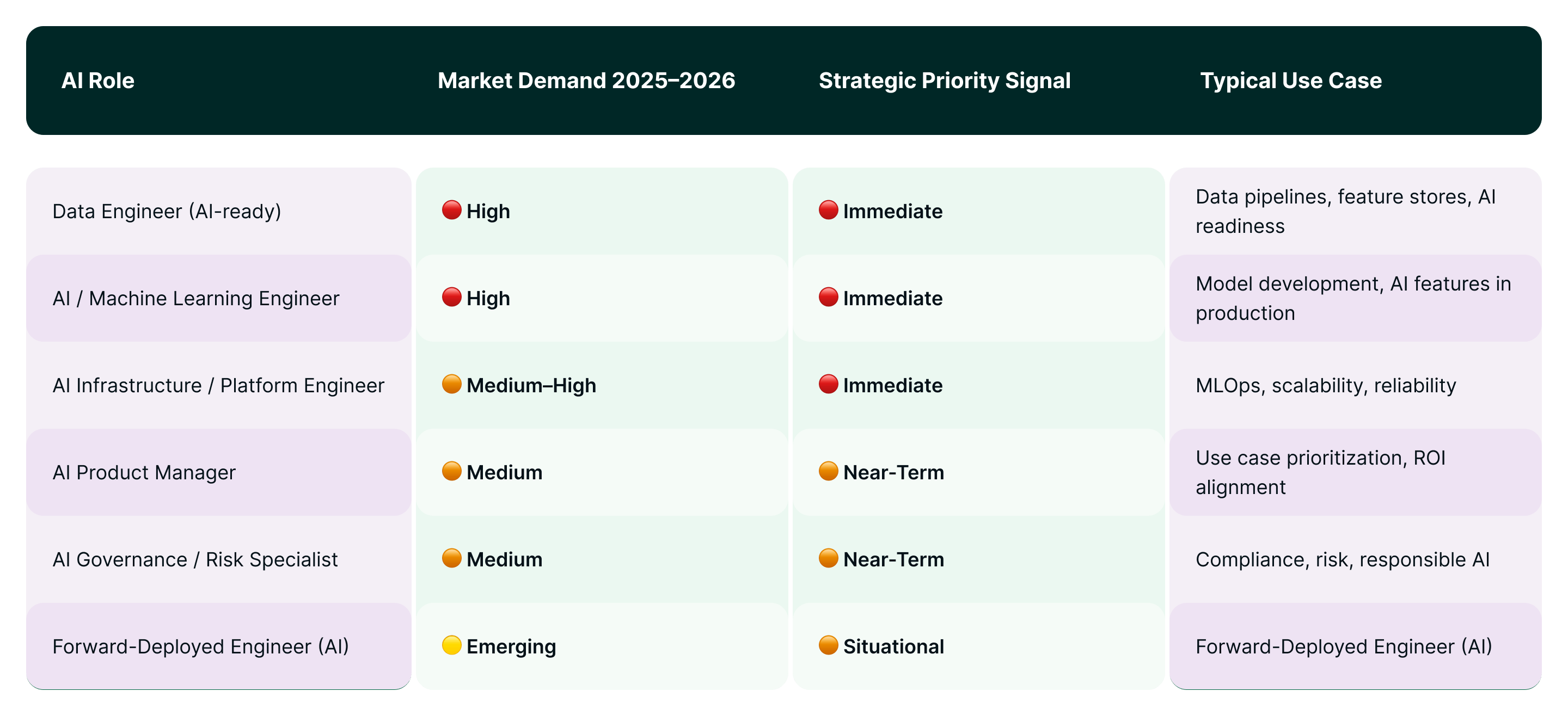
Sources consistently tracking these trends include Gartner, McKinsey & Company, and large-scale hiring platforms like Robert Half and Levis.
How to read this:
- 🔴 High means talent scarcity and rising competition
- 🟠 Medium indicates growing demand tied to the maturity stage
- 🟡 Emerging signals roles are gaining traction but not yet mainstream
Successful engineering leaders avoid siloed jobs. The AI hire should be part of a web that includes Software engineering, Data infrastructure, Product management, Security, and compliance. At scale, these functions must co-exist to support AI-driven business outcomes.
Strategic Trade-offs: How to Decide
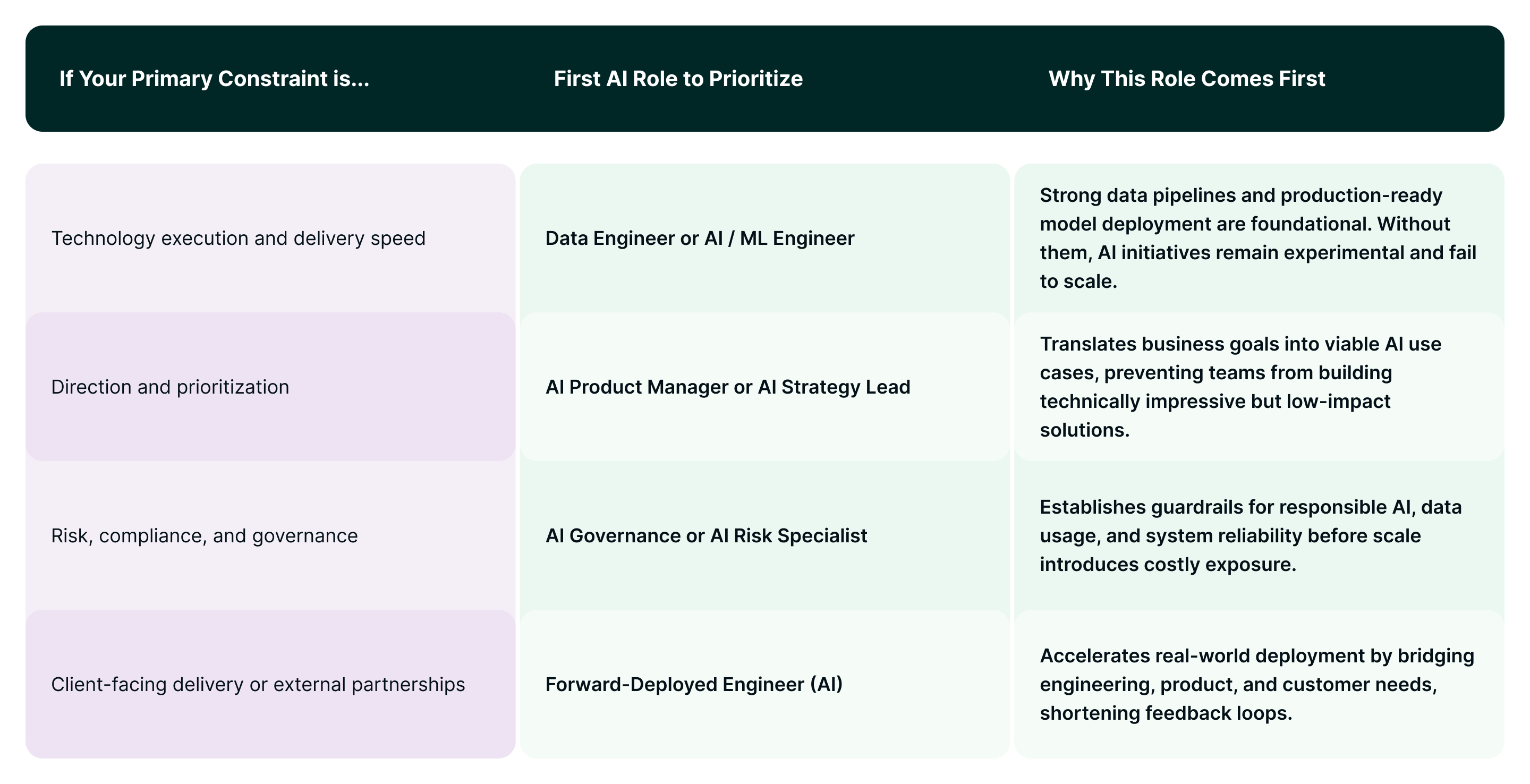
Choosing the first AI hire must reflect your organization’s current maturity, core bottlenecks, and AI strategy.
Here is a simple decision framework:
Cost Reality of Engineering Talent
Engineering leaders navigate a continuous trade-off when scaling teams, weighing the cost, speed, and seniority of talent. While hiring senior staff accelerates execution and improves quality, relying on less experienced employees risks delays and costly rework, often offsetting initial cost savings.
Strategic leadership is crucial for finding the right balance of expertise,a mix that ensures both rapid progress and well-informed decision-making.
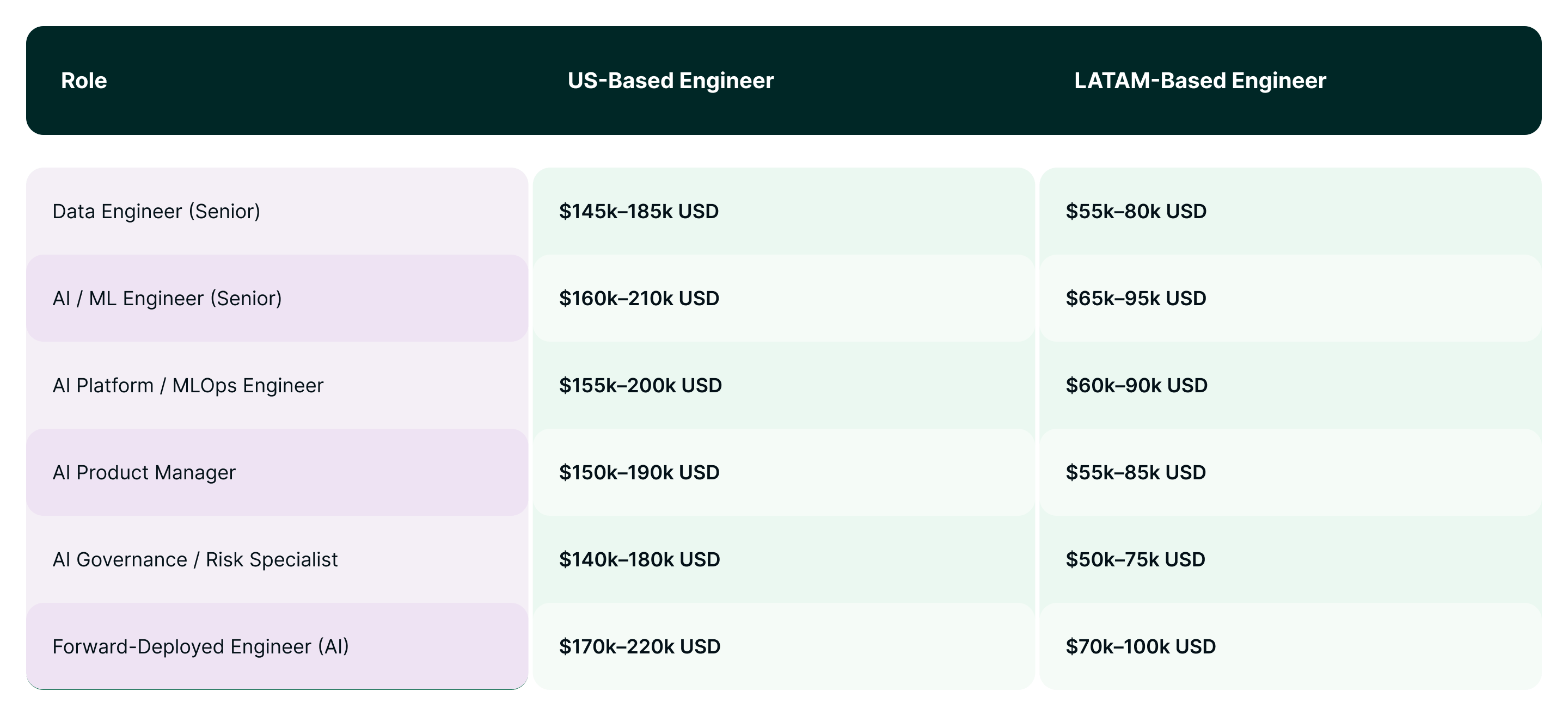
Estimated Annual Total Cost Ranges (2025)
Important context:
- US salaries are driven by scarcity, equity expectations, and competition with hyperscalers
- LATAM senior engineers increasingly bring production-level AI experience at lower total cost, especially when embedded into strong delivery models
- Cost efficiency only works when seniority, communication, and architectural alignment are prioritized
What’s Different in 2026
Several market shifts leaders should consider:
- AI adoption is pervasive and across roles. Over 84% of developers use or plan to use AI tools daily.
- Governance, responsible AI practices, and system thinking are now elevated alongside product and engineering functions.
- Data readiness still lags behind model hype, making data-centric roles strategic enablers.
Therefore, initial AI hires need to be strategically positioned; technical competence alone is insufficient.
Closing Thought
Hiring your first AI professional is a strategic decision that fundamentally dictates your technical architecture, speed of delivery, and future risk management as you move toward 2026.
Continue reading: The Risk of Invisible Debt: System Mapping in the Age of Technical Fragility


