
BLOG
Why AI Initiatives Fail After the Prototype Phase

What Breaks First in 2026, Architecture, Data, or AI Operating Models?
Many organizations have demonstrated their ability to build compelling AI prototypes. These initiatives often validate technical feasibility, generate internal alignment, and suggest meaningful business potential. Yet despite this early success, a significant share of AI initiatives fail to mature into reliable, scalable production systems.
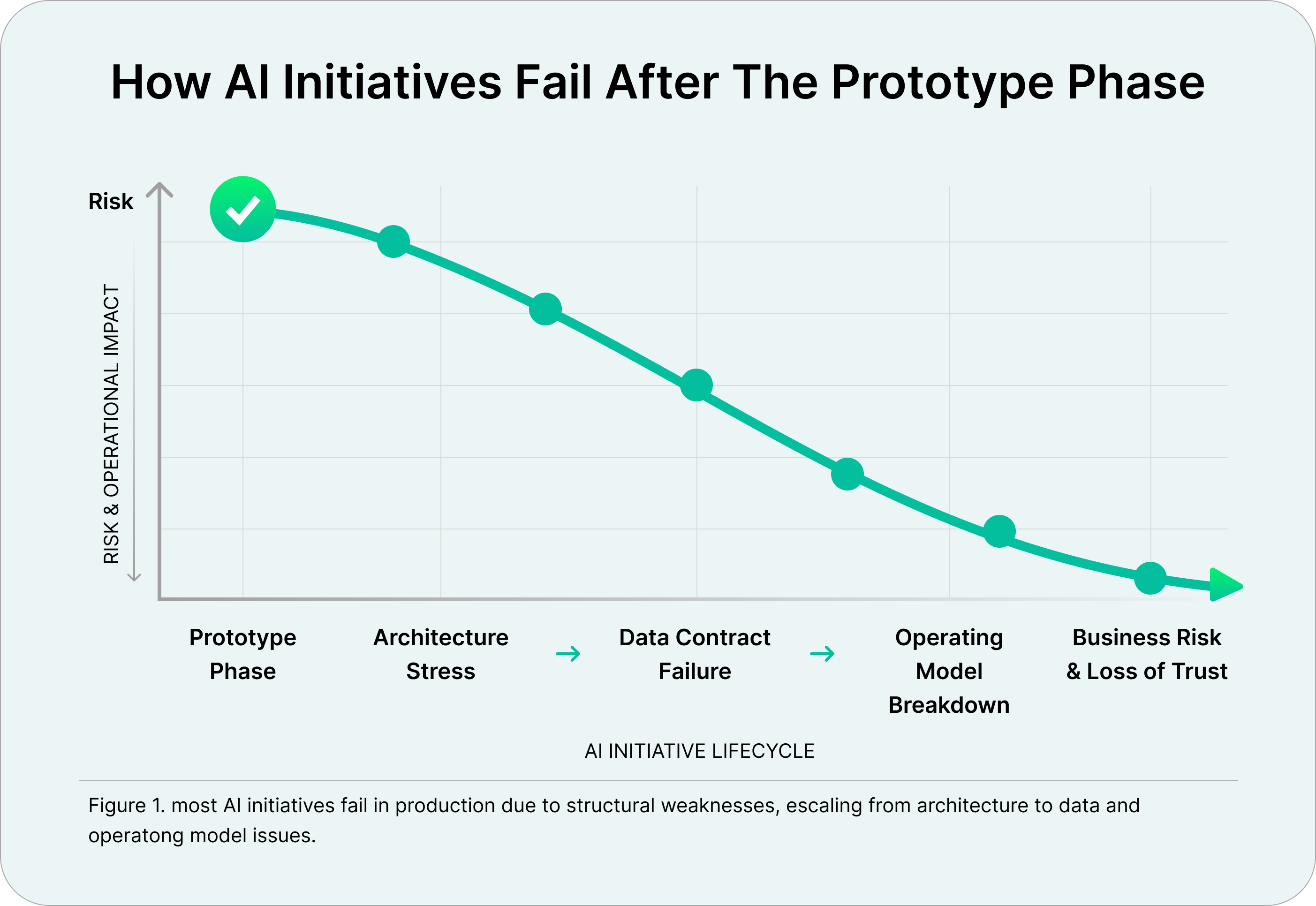
As organizations move toward 2026, this gap between successful experimentation and durable execution is becoming increasingly consequential. The causes are rarely rooted in model performance or talent availability. Instead, they reflect deeper structural misalignments in architecture, data foundations, and operating models.
Understanding where and why AI initiatives break down after the prototype phase is essential to avoiding costly rework and lost momentum.
The Prototype Phase and Its Structural Limitations
AI prototypes are designed to answer a narrow question: whether a given approach is technically viable. As such, they are intentionally optimized for speed and flexibility rather than resilience or governance. Constraints around data variability, system dependencies, and operational accountability are typically minimized or deferred.
This design choice is appropriate for experimentation. However, it often leads organizations to underestimate the scope of change required to move from prototype to production. According to McKinsey & Company, many AI initiatives stall after pilot stages because organizations treat productionization as an incremental step rather than a systemic transition.
The result is a pattern in which prototypes succeed, but the underlying organization is not prepared to support AI as a long-lived capability.
The First Failure Point, Architecture
The earliest and most common failure point is architecture, specifically the way responsibilities and decision boundaries are defined across systems.
Most existing software architectures are designed around deterministic behavior and predictable failure modes. AI systems introduce probabilistic outputs, evolving behavior, and dependencies on external signals that change over time. When these systems are embedded into tightly coupled service architectures, even minor instability can propagate widely.
Gartner has highlighted that AI workloads place distinct demands on application architectures, particularly when AI components are treated as interchangeable services rather than systems with their own lifecycle, performance characteristics, and risk profile.
In practice, architectural fragility often manifests as difficulty isolating AI behavior, managing latency under load, or adjusting AI functionality independently of core services. These challenges are not easily addressed through model optimization alone.
The Second Failure Point, Data Contracts and Assumptions
When architectural stress becomes visible, attention often turns to data quality. While data issues are real, the underlying problem is more accurately described as unstable data assumptions.
AI prototypes are validated using controlled datasets and fixed feature definitions, conditions which do not reflect production environments. In production, data distributions shift, upstream systems change, and contextual signals can weaken or vanish. This means that, over time, AI systems will inevitably diverge from their validated state unless there are explicit mechanisms in place for data contracts, clear ownership, and continuous monitoring.
Persistent underperformance of AI in production is frequently attributed to data drift and feature instability, especially in organizations lacking clear accountability for long-term data behavior. This decline in AI output reliability then leads teams to implement manual checks and overrides, which consequently increases operational overhead and decreases overall system effectiveness.
The Most Difficult Failure to Resolve, Operating Models
The core failure often lies in the operating model. Since AI systems inevitably lead to unforeseen behavior when impacting areas like customer interaction, pricing, or internal decisions, organizations frequently find themselves in a situation where responsibility is scattered. This fragmentation across teams means there is a lack of clear authority to properly assess risk, approve necessary changes, or even halt deployment, which is the most consequential breakdown.
Organizations that successfully scale AI treat AI systems as products with defined ownership, governance, and lifecycle management. Where this discipline is absent, AI initiatives accumulate risk faster than value, undermining trust among both engineering teams and business stakeholders.
How High-Growth Organizations Are Responding
The success of organizations in this transition is less about having more advanced models and more about making earlier, more intentional structural decisions.
Leading organizations treat AI as a long-term, evolvable capability that requires governance. Their successful practices consistently include:
- Architectural Isolation and Defined Boundaries: AI systems are isolated with clear interfaces and explicit failure boundaries.
- Production Ownership and Governance: The ownership of AI behavior in a production environment is explicitly assigned and enforceable. Operating models include defined paths for escalation and decision-making regarding AI-driven outcomes.
- Integrated Data and Monitoring: Data pipelines are built to support both inference and continuous monitoring of the AI system.
Conclusion
AI initiatives often stall after the prototype stage because organizations fail to grasp the fundamental structural changes necessary to reliably integrate AI into their systems, a problem that is less about selecting the right model or tool and more about whether the existing architecture, data foundations, and operating model can effectively sustain AI once it evolves into a business-critical component.
If you are thinking about how to evolve beyond experimentation and intentionally design for this shift, you may find value in our related article, The Rise of AI-Native Development: A CTO’s Playbook for Transforming Software Delivery. It explores how engineering leaders are restructuring delivery models, decision frameworks, and platforms to make AI a first-class capability rather than an afterthought.


