The Financial and Operational Physics of Technical Debt


The current landscape of enterprise engineering is defined by a paradox: the systems that generate the most revenue are often the ones that present the highest risk to modify. According to Gartner’s 2025 IT Outlook, organizations are now allocating an average of 38% of their total IT budget strictly to the management of technical debt, a figure projected to rise to 41% by 2026 if systemic modernization is not addressed. This expenditure is not an investment in growth; it is a premium paid for stability in increasingly fragile environments.
For a Director of Engineering in a compliance-heavy sector, the challenge is not simply the age of the code, but the accumulation of "undocumented complexity." This complexity creates a non-linear relationship between changes and outages. In systems where dependencies are obscured by years of hotfixes and shifting architectural standards, the primary constraint is no longer developer velocity, but risk tolerance. The cost of a production failure in a high-stakes fintech environment—encompassing regulatory fines, reputational damage, and immediate revenue loss—often outweighs the perceived benefits of rapid feature delivery.
Modernization as a Function of Risk Management
70% of large-scale modernization efforts fail to reach their stated objectives, often due to the underestimation of the "incidental complexity" embedded in legacy systems. These systems do not just perform functions; they embody decades of edge cases, regulatory nuances, and institutional memory that are rarely captured in modern requirements documents
Effective modernization requires a shift from viewing the process as a software engineering project to viewing it as a risk mitigation strategy. The goal is not to reach a "modern" state, but to reduce the probability and impact of system failure while slowly decoupling the monolith. This requires a forensic approach to the existing architecture before a single line of replacement code is deployed.
Establishing Systemic Certainty: The Discovery Phase
In a high-compliance environment, "move fast and break things" is an operational liability. The first stage of modernization must focus on visibility. Most legacy systems lack the telemetry required to understand their own internal state. When the logic is buried in stored procedures or tightly coupled monoliths, the first priority is establishing an observability layer that maps the system’s actual behavior against its documented intent.
This is where automated analysis tools, often augmented by Large Language Models (LLMs), provide the highest value. Rather than using AI to generate new code, which introduces its own set of validation risks, the pragmatic approach is to use it as a discovery engine. AI can parse millions of lines of undocumented COBOL, Java, or C# to identify hidden dependencies, dead code paths, and side effects that would take a human engineer months to map. This reduces the "blind spots" that typically lead to production regressions during migration.
By 2026, prediction set that 60% of modernization leaders will prioritize "AI-assisted code comprehension" over "AI-assisted code generation." This reflects a growing industry awareness that the hardest part of modernization is not writing the new system, but understanding what the old one actually does.
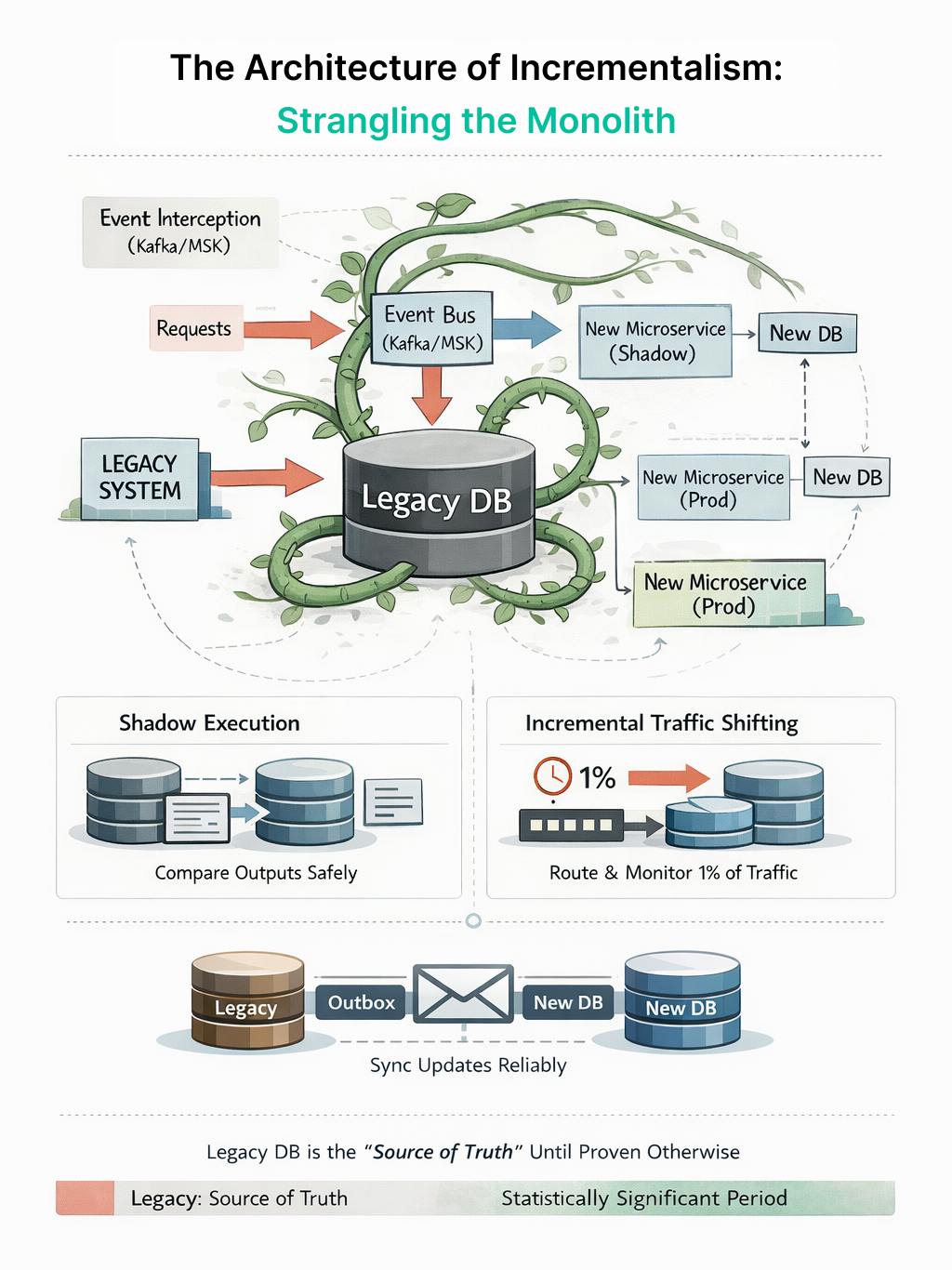
The Architecture of Incrementalism: Strangling the Monolith
The most reliable path forward is the application of the Strangler Fig pattern, but executed with a focus on data integrity and transactional consistency. In a fintech context, the challenge is often the database, the "gravity" that keeps the monolith intact. Attempting to modernize the application layer while leaving a shared, fragile database at the center often results in "distributed monoliths" rather than true microservices.
Decoupling via Data Synchronization
To modernize without breaking production, the strategy must involve Event Interception. Instead of a direct cutover, a proxy layer or an event bus (such as Kafka or Amazon MSK) is introduced to capture requests. This allows for:
- Shadow Execution: Running the new service in parallel with the legacy system and comparing outputs without the new system's results affecting production data.
- Incremental Traffic Shifting: Routing 1% of non-critical traffic to the new service and monitoring for deviations in latency or error rates.
- Transactional Integrity: Using the Outbox Pattern to ensure that updates to the legacy database and the new microservice’s data store remain synchronized, preventing data drift.
This approach acknowledges that the legacy system is the "source of truth" until the new component has proven its reliability over a statistically significant period.
Validation as a First-Class Citizen
In a compliance-heavy organization, the definition of "done" must include an exhaustive validation phase. Modernizing a mission-critical system requires a level of testing that goes beyond standard unit and integration tests.
Traffic Mirroring (or Dark Launching) is the gold standard for this. By duplicating live production traffic and sending a copy to the modernized service, engineers can observe how the new code handles real-world payloads, concurrency, and edge cases. This provides empirical proof of stability before the legacy system is ever decommissioned.
Furthermore, for fintech organizations, Regression Testing must be automated at the interface level. According to Deloitte’s 2025 Tech Trends, companies that implement automated contract testing see a 45% reduction in production incidents related to modernization. This ensures that as the monolith is chipped away, the remaining components continue to interact correctly with the new services.
Managing the Human and Compliance Constraints
Modernization is as much an organizational challenge as it is a technical one. In many legacy environments, the original architects are no longer with the company. This creates an "expertise vacuum" that leads to a defensive engineering culture. The fear of breaking the system becomes the primary driver of technical decisions.
To counter this, the modernization process must be transparent to security and compliance teams. By framing modernization as a way to harden security, for example, by moving from hard-coded credentials to identity-based access management (IAM) or by improving auditability, the engineering team can align their technical goals with the broader organization's risk-reduction mandates.
The goal is to reduce the cognitive load on the engineering staff. A monolithic system is difficult to maintain because no single person can hold the entire architecture in their head. Incremental modernization, by definition, breaks the system into smaller, more manageable domains, allowing teams to own specific outcomes rather than just managing a "black box."
Engineering for Continuous Health in 2026
Leading organizations are transitioning to a model of continuous modernization, where the health of the codebase is monitored as closely as the performance of the servers.
This shift requires a change in mindset from "completion" to "evolution." The systems being built toda . By prioritizing modularity, clear interfaces, and comprehensive telemetry now, engineering leaders can ensure that the next phase of modernization doesn't require the same level of heroic effort and risk.
Modernizing legacy systems without breaking production is not achieved through a single architectural choice or a specific tool. It is achieved through a disciplined adherence to incrementalism, observability, and empirical validation. Unnoticed transition of traffic from an old world to a new one, while the business continues to operate without interruption.
Advancing Your Modernization Strategy
As you evaluate the risks inherent in your current systems, the next step is often a technical audit focused on dependency mapping and risk-surface identification.
Modernizing legacy systems is fundamentally a shift from managing a monolithic, high-risk operational liability to engineering a continuous, evolvable architecture. It is not a one-time project but a disciplined adherence to an incremental methodology.
By prioritizing forensic discovery (leveraging tools like AI-assisted code comprehension), applying strategic decoupling patterns like the Strangler Fig, and establishing empirical validation through traffic mirroring and automated contract testing, organizations can successfully reduce technical debt.
This approach reduces system failure probability and impact, transforming modernization from a costly, feared chore into a consistent, risk-mitigating function that safeguards both operational stability and future growth. The goal is to move beyond the fear of breaking things and build systems designed for continuous health in a state of controlled evolution.
Summary of Key Takeaways
- Risk Tolerance is the Constraint: Technical debt management in high-compliance settings is constrained by risk, prioritizing system stability over rapid feature delivery.
- Modernization is Risk Mitigation: Reframing modernization as a strategy to reduce system failure probability and impact.
- Prioritize Visibility: Initial Discovery must establish observability (often via AI code comprehension) to map system behavior and identify complexity.
- Decouple Incrementally: Use the Strangler Fig pattern with data integrity focus (e.g., Event Interception, Outbox Pattern) to avoid "distributed monoliths."
- Validate Empirically: Use Traffic Mirroring (Dark Launching) and automated contract testing for empirical proof of stability before decommissioning legacy components.
- Address Human and Compliance Factors: Manage organizational challenges like
Ready to delve deeper into the technical patterns discussed? Explore the next article to accelerate your modernization journey with VelX: VelX vs. Alternative AI Coding Tools: Choosing the Right AI Coding Partner for Software Delivery Solutions
Subscribe to our newsletter
Stay informed with the latest insights and trends in the industry