
BLOG
Why Modern Staff Augmentation Fails Without AI-Native Architecture

AI is rapidly transitioning from a competitive advantage to a fundamental necessity for engineering organizations. By 2026, it will be crucial for maintaining industry pace and competitiveness.
This shift is underscored by Gartner's prediction that more than 75% of enterprise software engineers will use AI-assisted development tools by 2028. North America is leading this adoption as AI capabilities are integrated into essential tools like IDEs, CI pipelines, and quality workflows. What began as a tool for boosting productivity is now fundamentally changing how software systems are designed, built, and scaled.
However, this transition has a significant, yet often overlooked, consequence: staff augmentation strategies designed for pre-AI environments are becoming incompatible with modern system operations. As AI-assisted engineering becomes the norm, simply adding engineers without ensuring the corresponding architectural readiness yields diminishing returns.
The core issue is not the quality of the talent being added, but rather the system's inherent ability to effectively translate that added capacity into sustained, productive capability.
Staff Augmentation in a Period of Structural Change
The historical efficacy of staff augmentation rested on the ability to divide engineering work into relatively independent, parallelizable units. This allowed teams to absorb additional capacity by simply adding engineers without incurring excessive coordination costs.
However, this foundational premise is increasingly outdated.
Modern engineering, especially in AI-driven systems, involves complex, interconnected systems. These rely on shared data foundations, standardized platform abstractions, and feedback loops that often cut across multiple teams. Consequently, engineers dedicate less time to isolated feature implementation and more time to navigating intricate systems whose performance is tightly coupled with data, underlying models, and real-time operational signals.
Organizations that attempt to scale digital and AI initiatives by merely increasing headcount, without first resolving these underlying system-level constraints, frequently see their progress stall. In such environments, simply adding more engineers may increase activity but fails to reliably improve concrete outcomes.
This shift marks the point where the traditional logic of staff augmentation begins to fail.
Why Capacity Alone No Longer Predicts Delivery Impact
When AI-enabled systems are used, the effectiveness of delivery is determined less by the output of individuals and more by the clarity with which the system communicates intent, ownership, and constraints.
Organizations that depend on staff augmentation without the necessary architectural foundation consistently exhibit several recurring issues:
Architectural opacity
AI-driven functions are typically spread across various services, pipelines, and models. When architectural boundaries are unclear, augmented engineers face challenges identifying the location of specific logic and predicting how modifications will affect the system. This ambiguity frequently leads to duplicated work, conflicting assumptions, and easily broken integrations.
Data dependency complexity
AI systems require continuously evolving data pipelines. Undocumented or poorly governed data dependencies (such as feature definitions, data freshness, and signal quality) directly impact system behavior and force engineers to spend excessive time on context reconstruction instead of valuable work.
Weak data architecture is showcased as a main obstacle to scaling AI initiatives beyond the initial stages, regardless of the team size.
Decision friction under uncertainty
AI introduces probabilistic outcomes and non-deterministic behavior, which presents a challenge in organizations whose operating models rely on predictable cause-and-effect. This inherent uncertainty hinders decision-making, leading to delayed releases, unclear ownership, and an overall loss of confidence. Under these conditions, the cost of coordination in staff augmentation rises more quickly than the actual increase in output or throughput.
AI-Native Architecture as an Enabler of Scale
The sustained success of organizations utilizing staff augmentation in AI-enabled settings is predicated on a shared essential element: AI-native architecture.
AI-native architecture is defined by system design that embraces continuous validation, evolution, and uncertainty, rather than merely incorporating AI models. These systems are structured around the assumption that behavior will shift over time, requiring insight to be generated through constant monitoring, not just through initial inference.
AI-native architectures are defined by several key characteristics that, ultimately, work to reduce the implicit knowledge needed for safe and effective action within the system.
These architectural foundations include:
- Clear Separation: Distinct delineation between core system logic and AI-driven components.
- Explicit Contracts: Well-defined interfaces and contracts governing how data and models interact.
- Built-in Observability: Integrated mechanisms to monitor model behavior, track drift, and measure impact.
- Standardized Workflows: Platform-level abstractions that standardize development and deployment processes.
Why AI-Native Architecture Changes Staff Augmentation Outcomes
When an organization has adopted an AI-native architecture, the dynamics of staff augmentation fundamentally change.
Augmented engineers are empowered to:
- Integrate rapidly due to clearly defined system boundaries.
- Implement changes confidently because system behavior is fully observable.
- Provide meaningful contributions immediately, without needing to reconstruct extensive historical context.
This results in a compounding benefit: every new engineer added increases the system's capability instead of simply adding to its complexity. According to Forrester research, organizations that successfully scale AI prioritize architectural discipline and operational clarity, which allows teams to expand without compromising system reliability.
Staff Augmentation as a Capability Strategy
As AI-assisted engineering becomes standard practice, staff augmentation must be evaluated through a different lens.
The strategic question shifts from:
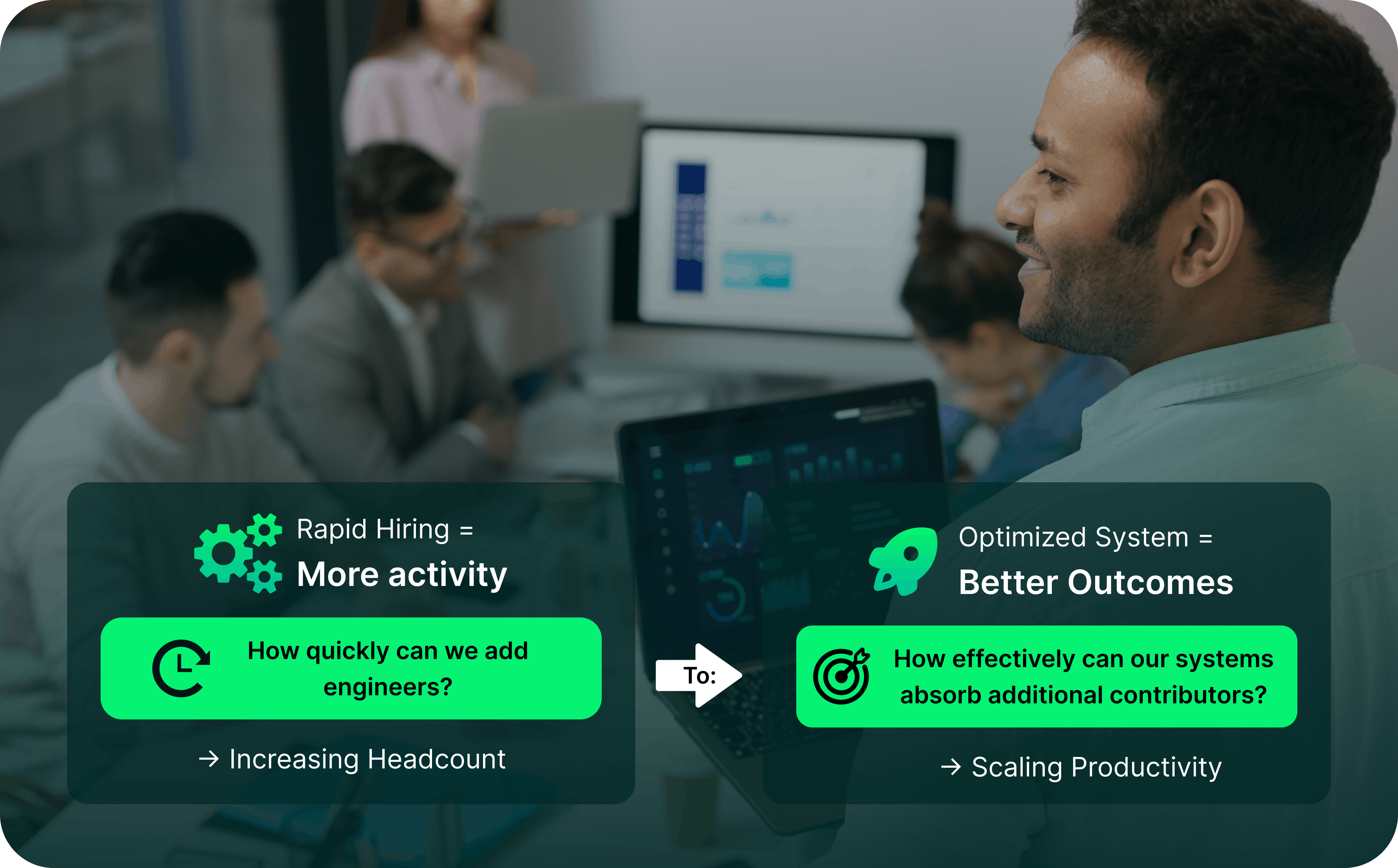
This reframing has concrete implications for leadership priorities:
- Platform consistency becomes a prerequisite for scaling teams
- Architectural documentation becomes operational infrastructure
- Data governance becomes a delivery accelerator, not a constraint
Organizations that treat staff augmentation as a capability strategy align hiring, architecture, and operating models around long-term system evolution.
The Future of Staff Augmentation: Architectural Readiness Over Team Size
By 2026, AI-assisted engineering will be a standard component of most enterprise software environments across North America. Scaling success is establishing an architecture where the existing team continuously elevates its value.
Staff augmentation will continue to be a vital and necessary approach. However, its success will be determined by an organization's architectural readiness to integrate AI, rather than its ability to rapidly hire personnel.
Closing
In the AI era, engineering leaders must recognize that foundational, AI-native architecture is the crucial prerequisite for sustainable scaling, not just an optional enhancement. This structure is what determines if increased capacity becomes a source of disruptive noise or a valuable strategic asset.
You might also be interested in: The Capacity Playbook: How Engineering Leaders Stabilize Delivery Velocity.


